-

04
May
Incoterms Full Comparison | All Shipping Terms Explained (2020 Guide)
Incoterms Full Comparison | Complete Guide
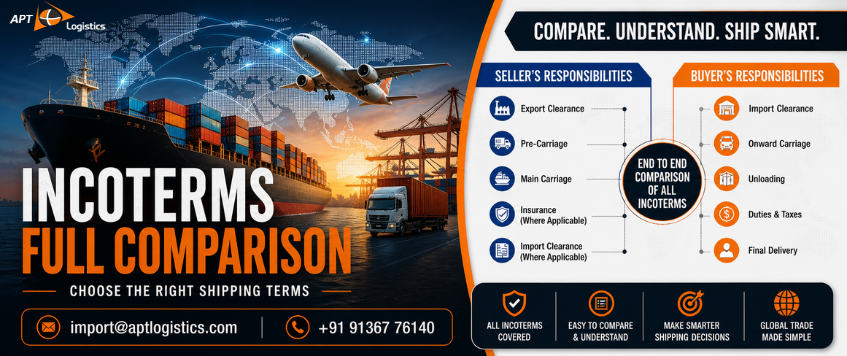
In international trade, selecting the right shipping term is crucial for defining cost, risk, and responsibility between buyers and sellers. This incoterms full comparison will help you understand all major trade terms and how they impact your logistics decisions.
Incoterms (International Commercial Terms) are standardized rules published by the International Chamber of Commerce (ICC) that simplify global trade transactions.
Why Incoterms Matter
Incoterms clearly define:
✔ Who pays for transportation
✔ Who handles customs clearance
✔ When risk transfers
✔ Who is responsible for insuranceChoosing the right term ensures smooth and dispute-free shipping.
Incoterms Categories
1. For All Modes of Transport
- EXW, FCA, CPT, CIP, DAP, DPU, DDP
2. For Sea & Inland Waterways
- FAS, FOB, CFR, CIF
Incoterms Full Comparison Table
Term Full Form Seller Responsibility Buyer Responsibility Risk Transfer EXW Ex Works Minimal Maximum At seller premises FCA Free Carrier Moderate Moderate At carrier handover CPT Carriage Paid To Freight paid Risk after handover At carrier CIP Carriage & Insurance Paid To Freight + insurance Moderate At carrier DAP Delivered At Place High Import clearance At destination DPU Delivered at Place Unloaded Very High Minimal After unloading DDP Delivered Duty Paid Maximum Minimal At final delivery FAS Free Alongside Ship Moderate Moderate Alongside ship FOB Free On Board Moderate Moderate On vessel CFR Cost and Freight Freight paid Risk after loading On vessel CIF Cost, Insurance, Freight Freight + insurance Moderate On vessel
Key Differences Explained
1. Cost Responsibility 💰
- EXW: Buyer pays almost everything
- FOB / CFR: Seller pays up to shipment stage
- DDP: Seller covers all costs
2. Risk Transfer ⚠️
Risk transfer varies significantly:
- EXW → At seller location
- FCA/CPT/CIP → At carrier handover
- FOB/CFR/CIF → At ship loading
- DAP/DDP → At destination
Understanding this is critical to avoid unexpected liability.
3. Insurance Coverage
- Included only in: CIP and CIF
- Not included in others
Buyers must arrange insurance separately if not included.
4. Customs Responsibility 📄
- EXW → Buyer handles export
- FCA/FOB → Seller handles export
- DDP → Seller handles both export and import
- DAP → Buyer handles import
Popular Incoterms Explained
EXW (Ex Works)
Seller provides goods at their premises. Buyer handles everything else.
ALSO READ | ExWorks Explained
FOB (Free On Board)
Seller loads goods onto ship; buyer takes over afterward.
ALSO READ | FOB explained
CIF (Cost, Insurance, Freight)
Seller pays freight and insurance to destination port.
ALSO READ | CIF Explained
DDP (Delivered Duty Paid)
Seller manages everything including duties and delivery.
ALSO READ | DDP Explained
Which Incoterm Should You Choose?
The right choice depends on:
✔ Experience in logistics
✔ Cost control requirements
✔ Risk tolerance
✔ Shipment type
✔ Destination country regulationsFor example:
- Beginners → DDP or CIF
- Experienced buyers → FOB or FCA
- Cost-focused → EXW or CPT
Common Mistakes to Avoid
🚫 Choosing based only on price
🚫 Ignoring risk transfer point
🚫 Not understanding hidden costs
🚫 Confusing similar terms (CFR vs CIF, CPT vs CIP)Proper understanding prevents costly errors.
How APT Logistics Helps
APT Logistics provides expert support in choosing and managing Incoterms:
✔ Incoterm consultation
✔ Cost comparison analysis
✔ Freight planning and execution
✔ Customs clearance support
✔ End-to-end logistics solutionsWe help businesses select the most efficient and cost-effective shipping terms.
Conclusion
This incoterms full comparison highlights how each term affects cost, risk, and responsibility in international trade. Choosing the right term can significantly improve efficiency and reduce logistics challenges.
With APT Logistics, you gain expert guidance and seamless execution for all your global shipping needs.
Need Help? Chat with us!
Start a Conversation
Hi! Click one of our members below to chat on WhatsApp