-

30
Apr
DAP Explained | Delivered At Place Guide, Process & Responsibilities | APT Logistics
DAP Guide | APT Logistics
In international shipping, choosing the right Incoterm is essential to define responsibilities, cost, and risk between buyers and sellers. One of the most practical and widely used terms is DAP (Delivered At Place). This guide explains it in detail, including meaning, process, responsibilities, advantages, and key considerations.
What is DAP (Delivered At Place)?
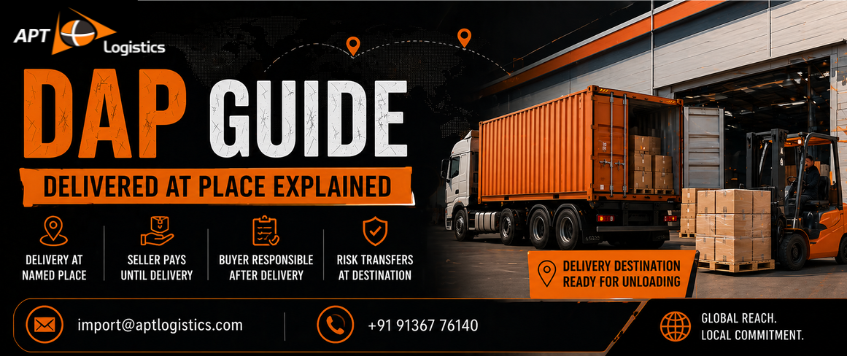
Delivered At Place is an Incoterm where the seller delivers goods to a specified destination agreed with the buyer. The seller handles transportation up to that location, but the buyer is responsible for import customs clearance, duties, and taxes.
Risk transfers from the seller to the buyer once the goods are ready for unloading at the destination.
Key Responsibilities Under DAP
Seller Responsibilities
- Prepare and package goods
- Arrange transportation (origin to destination)
- Handle export customs clearance
- Pay freight charges
- Deliver goods to agreed destination
Buyer Responsibilities
- Handle import customs clearance
- Pay duties and taxes
- Arrange unloading at destination
- Manage final handling after delivery
DAP Shipping Process (Step-by-Step)
1. Order Agreement 📦
Buyer and seller agree on DAP terms and specify the delivery location.
2. Cargo Pickup 🚛
The seller arranges pickup from their premises.
3. Export Clearance 📄
The seller completes export documentation and customs clearance.
4. Freight Transportation 🌍
Goods are transported via air, sea, or land to the destination country.
5. Arrival at Destination
The shipment reaches the agreed destination point.
6. Delivery at Place 🚚
The seller delivers the goods to the specified location (ready for unloading).
👉 Risk transfers at this stage.
7. Import Clearance
The buyer handles customs clearance, duties, and taxes.
DAP vs DDP (Quick Comparison)
Factor DAP DDP Seller Responsibility High Maximum Buyer Responsibility Moderate Minimal Duties & Taxes Buyer Seller Risk Transfer At destination (before unloading) At final delivery DAP is often preferred when the buyer wants control over import duties and compliance.
Advantages of DAP
1. Simplified Logistics for Buyer
The seller manages most of the shipping process.
2. Better Cost Transparency 💰
Buyers can directly handle duties and taxes.
3. Flexible Delivery Options
Suitable for door-to-door shipments.
Disadvantages of DAP
1. Buyer Handles Import Clearance ⚠️
This requires knowledge of local regulations.
2. Risk at Destination
The buyer assumes risk before unloading.
3. Coordination Required
Smooth delivery depends on good communication.
When Should You Use DAP?
DAP is ideal when:
- Buyer wants control over import duties
- Seller can manage transportation
- Shipment requires door delivery
- Both parties prefer shared responsibility
Common Mistakes to Avoid
- Confusion about unloading responsibility
- Ignoring import clearance requirements
- Not defining delivery location clearly
- Underestimating local charges
Clear agreements help avoid disputes.
How APT Logistics Helps
APT Logistics supports DAP shipments with:
- End-to-end transport coordination
- Export documentation support
- Freight planning (air & sea)
- Import clearance assistance
- Real-time shipment tracking
We ensure smooth delivery and efficient logistics management.
Conclusion
Understanding DAP is essential for businesses seeking a balance between control and convenience in international shipping. It allows sellers to manage transportation while giving buyers control over import duties and clearance.
With APT Logistics, you can handle DAP shipments efficiently, ensuring timely delivery and cost optimization.
Need Help? Chat with us!
Start a Conversation
Hi! Click one of our members below to chat on WhatsApp