-

02
May
CFR Explained | Cost and Freight Guide | APT Logistics
In international trade, understanding shipping terms is essential for managing cost and risk. One of the commonly used terms in sea freight is CFR (Cost and Freight). This guide explains the its shipping process, including responsibilities, steps, advantages, and key considerations.
What is CFR?
CFR (Cost and Freight) is an Incoterm used for sea and inland waterway transport. Under this term, the seller is responsible for delivering goods to the port of destination and paying for freight charges.
However, the risk transfers to the buyer once the goods are loaded onto the vessel at the origin port.
Key Responsibilities Under CFR
Seller Responsibilities
✔ Manufacture and package goods
✔ Arrange inland transport to port
✔ Handle export customs clearance
✔ Load goods onto vessel
✔ Pay ocean freight charges
Buyer Responsibilities
✔ Bear risk after loading
✔ Arrange insurance (not included)
✔ Handle import customs clearance
✔ Pay duties and taxes
✔ Arrange final delivery
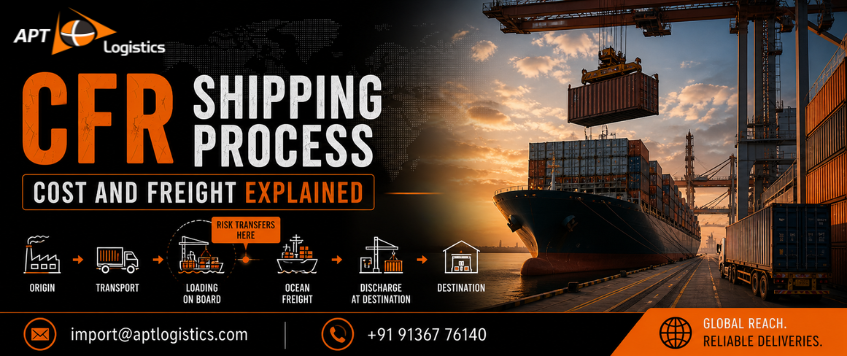
CFR Shipping Process (Step-by-Step)
1. Order Agreement 📦
Buyer and seller agree on CFR terms and finalize the contract.
2. Cargo Preparation
The seller prepares and packs the goods for shipment.
3. Inland Transport to Port 🚛
Goods are transported from the seller’s facility to the port of origin.
4. Export Clearance 📄
The seller handles export documentation and customs procedures.
5. Loading on Vessel 🚢
Goods are loaded onto the ship at the origin port.
👉 This is the critical point where risk transfers to the buyer.
6. Ocean Freight Transportation 🌍
The seller pays for shipping to the destination port.
7. Arrival at Destination Port
Goods reach the destination port as agreed.
8. Import Clearance & Delivery 🚚
The buyer handles customs clearance and arranges delivery to the final destination.
CFR vs CIF (Quick Comparison)
Factor CFR CIF Freight Cost Paid by seller Paid by seller Insurance Not included Included Risk Transfer At origin port At origin port Cost Level Lower Higher The main difference is insurance — CIF includes it, while CFR does not.
ALSO READ | CIF Explained | APT Logistics
Advantages of CFR
1. Seller Handles Freight
The buyer does not need to arrange ocean shipping.
2. Simplified Shipping Process
The seller manages export and freight coordination.
3. Cost Efficiency 💰
Generally cheaper than CIF since insurance is not included.
Disadvantages of CFR
1. Risk Transfers Early ⚠️
The buyer bears risk once goods are loaded.
2. No Insurance Included
The buyer must arrange cargo insurance separately.
3. Limited Control for Buyer
The buyer has less control over shipping arrangements.
When Should You Use CFR?
✔ Shipment is via sea freight
✔ Seller has better freight rates
✔ Buyer wants simplified shipping
✔ Insurance is arranged separately
Common Mistakes to Avoid
🚫 Assuming seller bears risk until destination
🚫 Not arranging insurance
🚫 Ignoring risk transfer point
🚫 Poor coordination with port handlingUnderstanding these points helps avoid unexpected losses.
How APT Logistics Helps
APT Logistics supports CFR shipments with:
✔ Export documentation and clearance
✔ Port handling and cargo loading
✔ Freight coordination
✔ Import clearance assistance
✔ End-to-end logistics solutionsWe ensure smooth and efficient shipping under CFR terms.
Conclusion
Understanding the CFR shipping process is essential for businesses involved in sea freight. While it offers cost efficiency and simplified shipping, it also requires careful risk management.
With APT Logistics, you can manage CFR shipments effectively, ensuring timely delivery and optimized costs.
Need Help? Chat with us!
Start a Conversation
Hi! Click one of our members below to chat on WhatsApp