-

23
Apr
CIF Cost Structure Explained | Complete Breakdown for Importers by APT Logistics
CIF Cost Structure Explained
In international trade, understanding pricing is critical for cost control and profitability. The CIF cost structure is one of the most commonly used pricing models, especially in sea freight transactions.
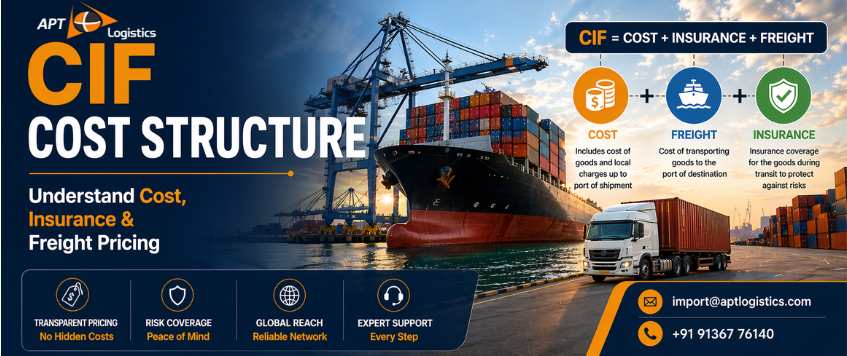
CIF (Cost, Insurance, and Freight) means the seller covers the cost of goods, transport, and insurance up to the destination port. However, many buyers misunderstand what is actually included — and more importantly, what is not.
What Does CIF Include?
Under this pricing model, the seller is responsible for:
- Cost of goods
- Export packaging
- Inland transport to port
- Export customs clearance
- Ocean freight charges
- Insurance coverage up to destination port
This makes CIF a convenient option for buyers who prefer minimal involvement in origin logistics.
CIF Cost Structure Breakdown
To fully understand CIF pricing, let’s break down its main components:
1. Cost of Goods 📦
This is the base price of the product agreed between buyer and seller. It forms the foundation of the total cost.
2. Inland Transportation 🚛
The seller arranges transport from their facility to the port of export. This includes trucking and handling charges.
3. Export Clearance Charges 📄
All export-related documentation, duties (if applicable), and customs procedures are handled by the seller.
4. Ocean Freight 🚢
The cost of shipping goods from the origin port to the destination port is included.
This is a major component of the CIF shipping cost breakdown and varies based on:
- Route
- Container size
- Market demand
5. Insurance Coverage 🛡️
The seller provides minimum insurance coverage for the cargo during transit.
💡 Important:
Insurance under CIF is usually basic and may not cover all risks.
What is NOT Included in CIF?
This is where many businesses miscalculate their total landed cost.
The buyer is responsible for:
❌ Import customs clearance
❌ Duties and taxes
❌ Port handling charges at destination
❌ Delivery to final location
❌ Additional storage or demurrageUnderstanding this distinction is crucial when evaluating import cost structure under CIF.
Hidden Costs to Watch Out For
Even though CIF appears simple, additional costs can arise:
- Terminal handling charges (THC)
- Documentation fees at destination
- Delivery order charges
- Port congestion surcharges
These costs are often not visible in the initial quote but impact the final expense.
CIF vs FOB Cost Perspective
From a cost perspective:
- CIF = Seller controls freight + adds margin
- FOB = Buyer controls freight + negotiates rates
While CIF offers convenience, FOB often provides better cost transparency and flexibility.
When Should You Use CIF?
This pricing model works best when:
- Buyer has limited logistics experience
- Seller has strong shipping arrangements
- Small to medium shipments are involved
- Simplicity is preferred over control
However, experienced importers often prefer alternatives for better cost optimization.
How APT Logistics Helps
APT Logistics helps businesses understand and optimize CIF-based shipments with:
- Transparent cost breakdown
- Freight rate benchmarking
- Import clearance support
- End-to-end logistics planning
- Cost optimization strategies
We ensure you understand the real cost — not just the quoted price.
Conclusion
Understanding the CIF cost structure is essential for accurate pricing and avoiding unexpected expenses in international trade. While it simplifies shipping for buyers, it’s important to evaluate all cost components and hidden charges.
With the right logistics partner, businesses can make informed decisions, reduce costs, and improve supply chain efficiency.
Need Help? Chat with us!
Start a Conversation
Hi! Click one of our members below to chat on WhatsApp