-

10
Oct
Open Top Container Shipping: Uses & Benefits
What Is Open Top Container Shipping?
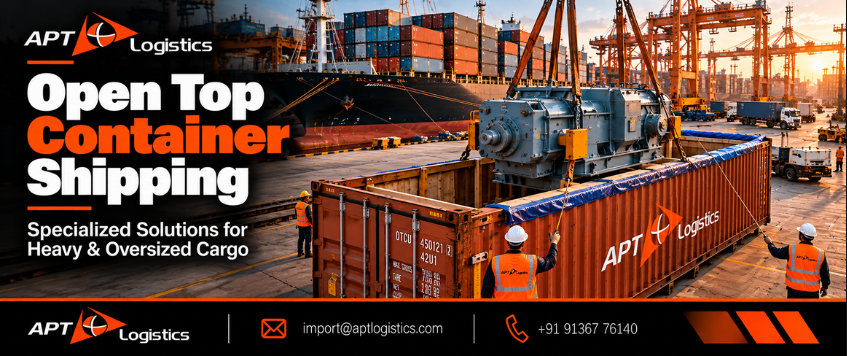
Open top container shipping is used when cargo requires loading from above or cannot be conveniently loaded through the doors of a standard shipping container.
Unlike a standard container, an open top container has a removable roof cover, typically a tarpaulin, and a roof structure designed to facilitate top loading. This makes it suitable for certain heavy, tall or awkwardly shaped cargo.
Exporters commonly use 20-foot and 40-foot open top containers to transport industrial machinery, equipment, steel products and other cargo that requires specialized loading arrangements.
When Should Exporters Use Open Top Containers?
1. When Cargo Requires Top Loading
Some cargo cannot easily be moved through standard container doors. Open top containers allow suitable cargo to be loaded from above using cranes or other lifting equipment.
Examples include industrial machinery, heavy components and large manufacturing equipment.
2. When Cargo Is Too Tall for a Standard Container
Cargo that exceeds the usable internal height of a standard container may require specialized equipment.
An open top container may accommodate certain tall items, subject to its dimensions, loading configuration and carrier restrictions. Cargo exceeding the container’s permitted dimensions may need to be handled as out-of-gauge (OOG) cargo.
3. When Shipping Heavy Industrial Equipment
Machinery with a high weight or difficult loading configuration can benefit from top-loading access.
Before booking, exporters must verify the container’s payload, floor-loading limits, lifting points, cargo weight distribution and securing requirements.
4. When Transporting Steel and Construction Materials
Open top containers can be suitable for certain steel products, industrial components, timber and construction materials that are easier to load from above.
However, cargo length, height, weight and weather protection requirements must be checked before selecting the equipment.
5. When Standard Containers Are Operationally Unsuitable
Even when cargo dimensions are within a standard container’s limits, the loading method may make a standard container impractical.
An open top container can provide a more suitable solution when cargo needs crane access from above.
Open Top Container vs Standard Container
Feature Open Top Container Standard Container Roof Removable cover or open-top arrangement Fixed roof Loading Can allow top loading Primarily door loading Suitable cargo Machinery, tall or awkward cargo General packaged cargo Weather protection Requires suitable covering and protection Enclosed structure Freight cost May be higher depending on route and availability Often more economical for general cargo Open top containers are not automatically suitable for every oversized shipment. Cargo exceeding the container’s permitted dimensions may require carrier approval and specialized OOG handling.
What Should Exporters Check Before Booking?
Before arranging open top container shipping, exporters should confirm:
-
Cargo dimensions: Length, width and height after packing.
-
Gross weight: Total packed weight and container payload limits.
-
Loading method: Crane access, lifting points and equipment availability.
-
Lashing and securing: Appropriate blocking, bracing and securing arrangements.
-
Weather protection: Tarpaulin condition and additional cargo protection where needed.
-
Port and carrier acceptance: Equipment availability, route restrictions and OOG approval where applicable.
-
Total cost: Ocean freight, special equipment charges, handling, lashing, trucking and other applicable charges.
Providing accurate cargo dimensions and photographs early can help the freight forwarder identify the right equipment and avoid booking changes.
How APT Logistics Supports Open Top Container Shipping
At APT Logistics, we coordinate specialized sea freight solutions for industrial machinery, heavy equipment and cargo requiring non-standard loading arrangements.
Our team reviews cargo dimensions, gross weight, loading requirements and destination restrictions before coordinating suitable equipment and transportation.
We can also assist with related logistics requirements, including port coordination, customs clearance, inland transportation and project cargo handling.
The objective is to select equipment that meets the cargo’s practical requirements while keeping the overall shipping plan efficient.
Conclusion
Open top container shipping is a practical option for exporters moving machinery, tall cargo and industrial goods that require loading from above.
The right equipment depends on cargo dimensions, weight, loading method, weather protection and carrier acceptance. Checking these details before booking can help prevent delays and unexpected costs.
APT Logistics — Specialized Container Shipping Solutions from India to Global Markets.
Frequently Asked Questions
1. What cargo can be shipped in an open top container?
Suitable cargo may include industrial machinery, heavy equipment, steel products and other goods requiring top loading, subject to container specifications and carrier approval.
2. What sizes are available for open top containers?
Common options include 20-foot and 40-foot open top containers, although availability depends on the carrier, location and trade lane.
3. Is an open top container suitable for OOG cargo?
It can be suitable for certain OOG cargo, but cargo extending beyond the container’s permitted dimensions requires appropriate carrier approval and specialized handling arrangements.
4. Are open top containers waterproof?
They are designed with a removable roof cover, but they should not automatically be treated as fully waterproof under all conditions. Cargo protection, tarpaulin condition and handling requirements should be assessed before shipping.
5. Is open top container shipping more expensive?
It can cost more than standard container shipping because of specialized equipment, handling and availability. The final cost depends on the route, cargo dimensions and operational requirements.
-
Need Help? Chat with us!
Start a Conversation
Hi! Click one of our members below to chat on WhatsApp