-

07
Oct
House BL vs Master BL: Key Differences for Exporters
House BL vs Master BL: What Exporters Need to Know
Understanding house BL vs master BL is important for exporters working with freight forwarders, NVOCCs and shipping lines. Both are Bills of Lading, but they are issued by different parties and serve different roles within the transportation process.
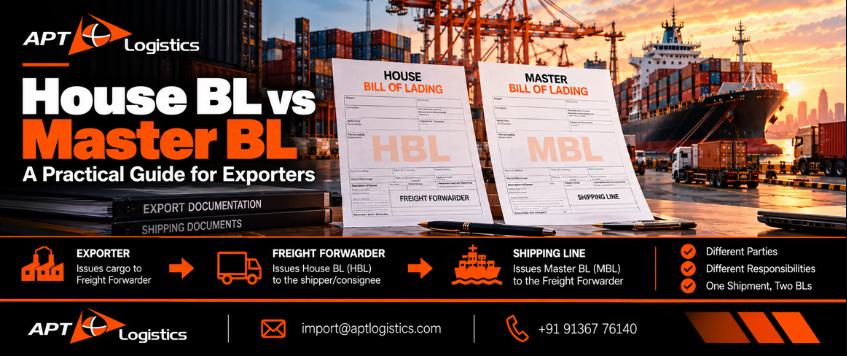
In simple terms, a House Bill of Lading (HBL) is generally issued by a freight forwarder or NVOCC to its customer, while a Master Bill of Lading (MBL) is generally issued by the actual ocean carrier to the contracting party, such as the forwarder or NVOCC.
What Is a House Bill of Lading?
A House Bill of Lading (HBL) is issued by a freight forwarder or NVOCC to the shipper.
It documents the transportation arrangement between the shipper and the forwarder/NVOCC and normally contains details such as:
- Shipper
- Consignee
- Notify party
- Cargo description
- Package details
- Gross weight
- Port of loading
- Port of discharge
- Container and shipment information
The HBL is commonly used when a freight forwarder manages the shipment and arranges the main carriage through a shipping line or another carrier.
What Is a Master Bill of Lading?
A Master Bill of Lading (MBL) is issued by the actual ocean carrier.
For example, if APT Logistics books cargo with a shipping line on behalf of an exporter, the carrier may issue the MBL to APT Logistics or the relevant contracting party, depending on the booking structure.
The MBL represents the transportation contract with the ocean carrier and contains the carrier’s shipment details.
House BL vs Master BL: Key Differences
Factor House BL (HBL) Master BL (MBL) Usually issued by Freight forwarder / NVOCC Shipping line / ocean carrier Issued to Shipper / customer Forwarder / NVOCC or contracting party Main purpose Documents forwarder’s transportation arrangement Documents carrier’s transportation arrangement Parties shown Customer and forwarder-related parties Carrier and contracting parties Commonly used in Forwarder-managed shipments Carrier booking How Do HBL and MBL Work Together?
In a typical forwarder-arranged shipment, both documents may exist.
For example:
Exporter → APT Logistics → Shipping Line → Destination
The exporter provides cargo and shipment instructions to APT Logistics. APT Logistics arranges the booking with the shipping line.
The shipping line issues the Master Bill of Lading, while APT Logistics may issue a House Bill of Lading to the exporter.
The two Bills of Lading therefore document different contractual relationships within the same physical shipment.
Why Is the Difference Important?
Understanding house BL vs master BL helps exporters avoid confusion when checking shipping documents.
The information across the HBL, MBL, commercial invoice, packing list and customs documentation should be properly coordinated. Differences can sometimes occur because the documents serve different contractual purposes, but critical shipment details must remain accurate and compliant.
Incorrect information can result in documentation amendments, customs queries, cargo release delays or additional costs.
HBL and MBL in Consolidated Shipments
HBL and MBL structures are particularly common in LCL consolidation.
A freight forwarder may collect cargo from multiple customers and consolidate it into one container. Each customer can receive an HBL, while the shipping line issues an MBL covering the consolidated container.
This allows the forwarder to manage individual customer shipments while maintaining the carrier-level transportation document.
How APT Logistics Manages HBL and MBL
At APT Logistics, our documentation team coordinates House and Master Bills of Lading with the shipper, carrier, overseas agent and other relevant stakeholders.
We carefully review shipment details including consignee information, cargo description, package quantity, weight, container details and routing information before documentation is finalized.
Proper coordination between HBL and MBL information helps support smoother export documentation and destination cargo release.
Conclusion
The key to understanding house BL vs master BL is knowing who issues each document and which transportation relationship it represents.
The HBL generally documents the relationship between the shipper and freight forwarder/NVOCC, while the MBL documents the carrier-level transportation arrangement.
For exporters, ensuring accurate and consistent documentation across both Bills of Lading is essential for smooth international shipping.
APT Logistics — Professional Freight Forwarding & Shipping Documentation Solutions from India to Global Markets.
FAQs
What is the difference between HBL and MBL?
An HBL is generally issued by a freight forwarder or NVOCC, while an MBL is issued by the actual ocean carrier.
Can one shipment have both an HBL and MBL?
Yes. Forwarder-arranged and consolidated shipments commonly involve both documents.
Who issues the House Bill of Lading?
Typically, the freight forwarder or NVOCC handling the shipment issues the HBL.
Who issues the Master Bill of Lading?
The shipping line or actual ocean carrier generally issues the MBL.
Is the HBL the same as the MBL?
No. They represent different contractual relationships and are issued by different parties, even though they may relate to the same physical cargo movement.
Need Help? Chat with us!
Start a Conversation
Hi! Click one of our members below to chat on WhatsApp