-

17
Nov
IGM Shipping India: Meaning, Filing Process & Importance
What Is Import General Manifest (IGM) and Why Does It Matter?
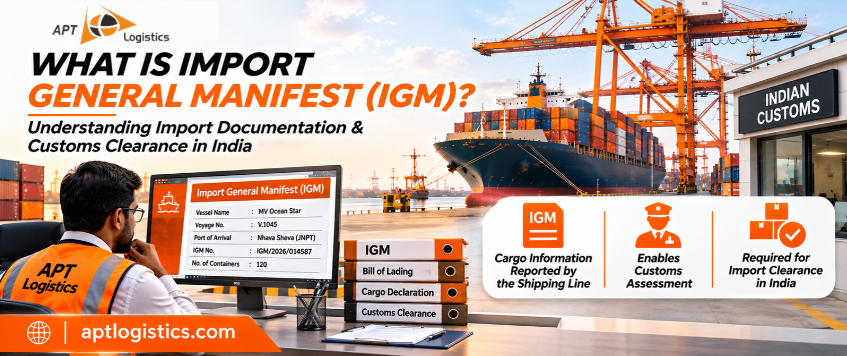
The Import General Manifest (IGM) is an important document in India’s import clearance process. It contains details of cargo carried by a vessel or aircraft arriving in India and helps customs authorities identify and account for incoming shipments.
For importers, freight forwarders, customs brokers, and shipping agents, understanding IGM shipping India procedures is essential because errors or delays in manifest filing can affect cargo identification, customs clearance, and delivery schedules.
The IGM process connects the carrier’s cargo declaration with the importer’s customs clearance documentation. Accurate manifest information helps ensure that imported cargo is properly reported to customs before arrival.
1. What Is an Import General Manifest (IGM)?
IGM stands for Import General Manifest. Traditionally, it refers to the cargo declaration submitted by the carrier or its authorised agent to Indian Customs before an incoming vessel or aircraft arrives.
The manifest contains information about the imported cargo being carried, including:
-
Importer or consignee details.
-
Shipper details.
-
Bill of Lading (B/L) or Air Waybill (AWB) details.
-
Cargo description.
-
Number of packages.
-
Gross weight.
-
Port of loading.
-
Port of discharge.
-
Container and shipment identification details, where applicable.
The purpose is to provide customs authorities with advance information about incoming cargo and enable proper accounting and processing.
Important regulatory update: Under Section 30 of the Customs Act, 1962, the legislation now refers to an “arrival manifest or import manifest”. For sea cargo, the Sea Cargo Manifest and Transhipment Regulations (SCMTR), 2018 introduced the electronic Arrival Manifest and Departure Manifest framework, replacing the earlier sea import and export manifest regulations. The term IGM nevertheless remains widely used in import operations.
2. Who Is Responsible for Filing the IGM?
The responsibility for submitting the applicable arrival or import manifest generally rests with the person in charge of the vessel or aircraft, the authorised carrier, or the designated authorised agent.
Depending on the mode of transport, the filing party may include:
-
Shipping line or authorised sea carrier.
-
Airline or authorised airline agent.
-
Vessel master or authorised shipping agent.
-
Other persons specifically authorised under applicable customs regulations.
Importers generally do not file the carrier’s IGM themselves. However, they must provide accurate shipment information to their overseas suppliers, freight forwarders, and carriers to support correct manifest filing.
Under Section 30 of the Customs Act, the arrival or import manifest for a vessel or aircraft is required to be presented electronically before arrival, subject to the applicable provisions.
3. What Information Is Included in an IGM?
An import manifest contains cargo-related information required by customs authorities to identify shipments arriving in India.
Common information includes:
Particulars Details Vessel / Flight Details Vessel name, voyage number or flight details Importer Details Consignee or importer name and address Shipper Details Exporter or shipper information B/L or AWB Number Shipment identification reference Cargo Description Description of imported goods Package Details Number and type of packages Gross Weight Declared shipment gross weight Port of Loading Origin port or airport Port of Discharge Indian destination port or airport Container Details Container number, where applicable The specific data fields and declaration requirements vary according to the mode of transport and applicable manifest regulations.
4. How Does the IGM Filing Process Work in India?
The import manifest process involves several stages.
Step 1: Shipment Details Are Collected
The carrier or its authorised agent collects shipment information from the relevant booking, transport, and cargo documents.
For sea freight, information is generally linked to the Bill of Lading and cargo declaration. For air freight, the Air Waybill and associated cargo information are important references.
Step 2: Manifest Is Prepared
The carrier prepares the applicable arrival or import manifest using the required cargo and conveyance details.
Accuracy is important because discrepancies may require subsequent amendments.
Step 3: Electronic Filing With Customs
The authorised carrier or agent submits the required manifest electronically through the prescribed customs system.
For sea cargo under SCMTR, the Arrival Manifest is submitted electronically by the authorised sea carrier or authorised sea agent.
Icegate+1
Step 4: Customs Receives the Manifest
The manifest provides customs authorities with advance information about the cargo arriving at the relevant customs station.
Step 5: Cargo Arrival and Import Processing
Once the vessel or aircraft arrives, the importer or customs broker can coordinate the applicable import documentation and clearance process.
The Bill of Entry and manifest information must be properly aligned to support cargo identification and clearance.
Step 6: Cargo Clearance and Delivery
After completing the required customs assessment, duty payment, examination, and other formalities, the importer can arrange cargo release and final delivery.
Note: Manifest filing alone does not constitute customs clearance or authorise cargo delivery.
5. Why Is IGM Important for Import Customs Clearance?
IGM filing is important because it establishes the carrier’s declaration of incoming cargo with customs authorities.
Its importance includes:
Cargo identification: It helps customs identify shipments arriving on a particular vessel or aircraft.
Bill of Entry processing: Accurate manifest details help establish consistency between the carrier’s cargo declaration and the importer’s customs declaration.
Shipment tracking: Manifest and associated cargo references support shipment identification and operational coordination.
Regulatory compliance: Timely and accurate filing supports compliance with customs manifest requirements.
Cargo release coordination: Correct manifest information helps avoid discrepancies that may delay further import formalities.
6. What Happens If There Is an Error in the IGM?
Incorrect or incomplete manifest information can create complications during import clearance.
Common IGM errors include:
-
Incorrect importer or consignee name.
-
Wrong Bill of Lading or Air Waybill number.
-
Incorrect cargo description.
-
Mismatch in package quantity.
-
Incorrect gross weight.
-
Wrong container number.
-
Incorrect port of discharge.
-
Missing cargo entry.
Such discrepancies may require an amendment or supplementary declaration before the import process can proceed smoothly.
How Are IGM Amendments Handled?
Under Section 30(3) of the Customs Act, the proper officer may permit an incorrect or incomplete arrival or import manifest to be amended or supplemented, subject to the applicable conditions.
The amendment process may require:
-
Identification of the discrepancy.
-
Supporting documents from the carrier or authorised agent.
-
Submission of an amendment request.
-
Customs verification and approval, where required.
-
Payment of applicable amendment fees, if any.
The nature of the correction and the customs authority’s requirements determine the procedure.
IndiaCode+1
7. Difference Between IGM and Bill of Entry
Importers sometimes confuse the IGM with the Bill of Entry. Both are important, but they serve different purposes.
Parameter IGM / Arrival Manifest Bill of Entry Purpose Declares incoming cargo to customs Declares imported goods for customs clearance Generally filed by Carrier or authorised agent Importer or authorised customs broker Main information Conveyance and cargo details Importer, goods, classification, value and duty details Filing stage Before arrival, as applicable According to the applicable import clearance procedure Main objective Report incoming cargo Obtain customs assessment and clearance In simple terms, the carrier reports the incoming cargo through the manifest, while the importer declares the goods through the Bill of Entry for customs processing.
8. IGM in Sea Freight vs Air Freight
The manifest process differs depending on the mode of transportation.
IGM in Sea Freight
For sea freight, the manifest process is governed by the Sea Cargo Manifest and Transhipment Regulations, 2018.
The authorised sea carrier or agent submits the electronic Arrival Manifest, which includes the prescribed vessel and cargo declarations.
Shipping documents such as the Bill of Lading provide important shipment references.
IGM in Air Freight
For air freight, the airline or its authorised agent submits the applicable arrival or import manifest before the aircraft arrives.
The Air Waybill serves as an important reference for identifying the cargo and linking it with the importer’s customs documentation.
Both processes are important for reporting incoming cargo, although their technical filing requirements and systems differ.
9. How APT Logistics Supports Importers With IGM and Customs Coordination
At APT Logistics, we understand the importance of accurate import documentation and timely coordination between carriers, customs brokers, and importers.
Our team supports businesses with:
-
Import documentation coordination.
-
Bill of Lading and Air Waybill verification support.
-
Import customs clearance coordination.
-
Shipping line and airline follow-ups.
-
Manifest discrepancy coordination with the relevant carrier or agent.
-
FCL and LCL import shipment handling.
-
Port and airport cargo transportation.
-
Final delivery and inland transportation arrangements.
We help importers coordinate shipment documentation and cargo movement to reduce avoidable discrepancies and operational delays.
Conclusion
The Import General Manifest is an important part of India’s import cargo reporting and customs clearance framework. It provides customs authorities with advance information about cargo arriving by sea or air and helps establish shipment identification for further import processing.
Understanding IGM shipping India requirements, checking shipment information carefully, and coordinating corrections promptly can help importers avoid unnecessary documentation issues and cargo clearance delays.
APT Logistics supports importers with freight forwarding, import documentation coordination, customs clearance, and inland transportation solutions to help manage international shipments efficiently.
3. Frequently Asked Questions (FAQs)
Q1. What is IGM in shipping?
IGM stands for Import General Manifest. It traditionally refers to the cargo declaration submitted by the carrier or its authorised agent to customs authorities for incoming shipments.
Q2. Who files the IGM in India?
The vessel or aircraft’s person in charge, authorised carrier, or designated authorised agent is responsible for submitting the applicable arrival or import manifest under customs requirements.
Q3. When should the IGM be filed?
Under Section 30 of the Customs Act, the arrival or import manifest for a vessel or aircraft is required to be presented electronically before arrival, subject to applicable provisions and permitted exceptions.
Q4. What is an IGM number?
An IGM number is a reference associated with the filed import manifest. It helps identify the manifest record and related cargo entries in customs processing.
Q5. What happens if the IGM contains incorrect information?
Incorrect or incomplete information may require amendment or supplementation through the applicable customs procedure. The correction may require supporting documents and customs approval.
Q6. Is IGM required for both sea freight and air freight?
Both sea and air cargo are subject to arrival or import manifest reporting requirements. However, the applicable regulations, electronic filing formats, and operational procedures differ.
Q7. What is the difference between IGM and Bill of Entry?
IGM is the carrier’s declaration of incoming cargo, while the Bill of Entry is the importer’s declaration for customs assessment and clearance.
Q8. Can an importer directly amend the IGM?
The manifest is generally filed by the carrier or its authorised agent. An importer who identifies an error should coordinate with the carrier, shipping agent, or customs broker to initiate the appropriate amendment process.
APT Logistics – Contact Details
For air freight, sea freight, sales, documentation, and import requirements, contact our respective teams:
Department Email Contact Number Air Freight docs@aptlogistics.com +91 79776 10560 Sea Freight ocean@aptlogistics.com +91 99200 20978 Sales sales.desk@aptlogistics.com / sea@aptlogistics.com +91 7700 914 388 Documentation cs1@aptlogistics.com +91 91367 76040 Import cs02@aptlogistics.com +91 9321740903 -
Need Help? Chat with us!
Start a Conversation
Hi! Click one of our members below to chat on WhatsApp