-

08
Oct
Surrender Bill of Lading: Complete Exporter Guide
What Is a Surrender Bill of Lading?
A surrender bill of lading is a Bill of Lading where the original negotiable B/L is surrendered to the carrier or issuing party at the origin, allowing cargo release at destination without requiring the consignee to present the original paper B/L, subject to the carrier’s release procedures.
It is commonly used when exporters and importers have an established commercial relationship and want to avoid sending original documents by courier before the cargo can be released.
The term surrendered B/L is often associated with a telex release, although the exact terminology and procedure can vary between shipping lines and forwarders.
How Does a Surrender Bill of Lading Work?
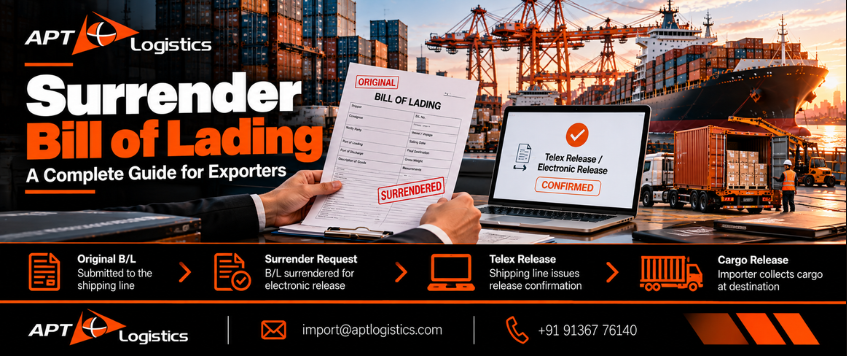
The process generally follows these steps:
1. Shipment Is Booked
The exporter arranges the shipment with a shipping line or freight forwarder and provides the required cargo and documentation details.
2. Bill of Lading Is Issued
After the cargo is loaded, the carrier or forwarder prepares the applicable Bill of Lading.
If the shipment is intended for surrender, the exporter can request the applicable release arrangement.
3. Original B/L Is Surrendered
The required original B/Ls are surrendered to the issuing carrier, forwarder or authorized party according to their procedures.
The carrier then records the surrender and provides the applicable release instruction.
4. Release Instruction Is Sent to Destination
The destination office or agent receives confirmation that the original B/L does not need to be presented for cargo release.
5. Importer Completes Destination Formalities
The consignee completes applicable customs, carrier payment and destination requirements before taking delivery of the cargo.
Why Do Exporters Use a Surrender B/L?
1. Faster Cargo Release
One of the biggest advantages is that the importer does not have to wait for physical original documents to arrive by courier.
2. Reduced Courier Delays
International shipments can reach the destination before original documents. Surrendering the B/L can reduce the risk of document-related delays.
3. Useful for Regular Business Relationships
It is often convenient when the exporter and importer have an established relationship and do not require control of cargo through possession of original negotiable B/Ls.
4. Simplified Documentation
The electronic release instruction can make the destination release process more straightforward, subject to carrier procedures.
Surrender B/L vs Original Bill of Lading
Factor Surrender B/L Original B/L Original document presentation at destination Generally not required for release Generally required for negotiable original B/L Physical document courier Usually avoided Often required Cargo release Based on carrier’s release instruction Based on presentation of required documents Speed Can facilitate faster release May take longer if originals are delayed Control Less documentary control once surrendered Greater control through possession of originals The exact process depends on the B/L type, carrier, trade route and applicable release procedures.
Surrender B/L vs Telex Release
These terms are frequently used together, but they are not necessarily identical.
A surrendered B/L describes the surrender of the original Bill of Lading to the issuing party.
A telex release generally refers to the carrier’s communication to its destination office or agent confirming that cargo can be released without presentation of the original B/L.
In everyday freight operations, the terms are often used interchangeably, but exporters should confirm the exact process with their carrier or freight forwarder.
Important Considerations Before Surrendering a B/L
A surrender arrangement should be used carefully because surrendering the original B/L can affect documentary control over the cargo.
Before requesting a surrender bill of lading, exporters should verify:
- Buyer and seller agreement.
- Payment terms and commercial relationship.
- Carrier’s surrender procedure.
- Consignee and notify party details.
- Customs requirements at destination.
- Applicable carrier and documentation charges.
- Whether any bank or letter-of-credit requirements apply.
For transactions involving letters of credit or strict documentary requirements, exporters should obtain appropriate professional and banking guidance before surrendering the B/L.
How APT Logistics Handles Surrender B/L Shipments
At APT Logistics, our documentation team coordinates surrendered B/L requirements with shipping lines, overseas agents and customers.
We verify the shipment details, release requirements and documentation instructions before requesting the applicable release from the carrier.
Our objective is to ensure that the surrender process is properly coordinated so the importer can complete destination formalities without unnecessary document-related delays.
Conclusion
A surrender bill of lading can simplify international cargo release by allowing the destination process to proceed without physically presenting the original negotiable B/L, subject to the carrier’s procedures.
It can save courier time and help avoid document-related delays, but exporters should use it only after confirming the commercial arrangement, payment terms and documentary requirements.
APT Logistics — Professional Export Documentation & Global Freight Forwarding Solutions.
FAQs
What is a surrender bill of lading?
A surrender bill of lading is a B/L where the original is surrendered to the carrier or issuing party so that cargo can generally be released at destination without presentation of the original B/L, subject to applicable procedures.
Is a surrender B/L the same as a telex release?
They are closely related but technically refer to different parts of the process. Surrender refers to giving up the original B/L, while telex release generally refers to the release instruction sent to the destination office or agent.
Why use a surrender B/L?
It can help avoid couriering original documents and may allow the importer to complete cargo release sooner.
Can a surrender B/L be used for every shipment?
Not necessarily. The suitability depends on the carrier’s procedures, commercial agreement, payment terms, B/L type and applicable regulatory or documentary requirements.
Is surrendering the B/L risky?
It can reduce documentary control over cargo. Exporters should therefore confirm payment arrangements, buyer instructions, carrier requirements and any bank or letter-of-credit conditions before surrendering the B/L.
Need Help? Chat with us!
Start a Conversation
Hi! Click one of our members below to chat on WhatsApp