-

03
Oct
Freight Prepaid vs Collect: Key Differences Explained
Freight Prepaid vs Collect: Understanding the Difference
When arranging an international shipment, understanding freight prepaid collect terms is important because they determine where the main freight charge is paid.
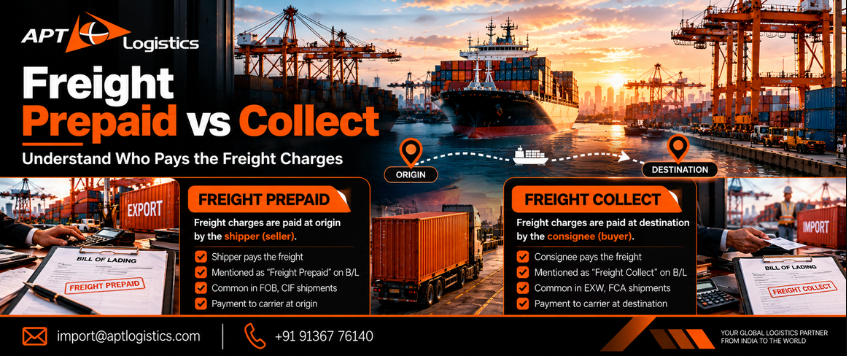
In simple terms, freight prepaid generally means the freight is paid at the origin, while freight collect generally means the freight is payable at destination.
However, the actual allocation of costs between buyer and seller depends on the agreed commercial terms, such as the Incoterm, sales contract and carrier arrangement.
What Does Freight Prepaid Mean?
Under a freight prepaid arrangement, the applicable ocean or air freight is paid at the origin before the shipment proceeds according to the carrier’s terms.
For example, an exporter in India may arrange a shipment from Nhava Sheva to Rotterdam with freight payable at origin.
The shipper or its appointed forwarder generally coordinates payment of the applicable freight with the carrier or service provider.
Important: Freight prepaid does not automatically mean that the seller is responsible for every logistics cost. Other charges may still be allocated according to the sales contract and Incoterm.
What Does Freight Collect Mean?
With freight collect, the applicable freight is generally payable at the destination.
For example, an Indian exporter may ship cargo to a customer in Europe under an arrangement where the ocean freight is collected from the receiving party at destination.
The carrier or its destination agent may collect the applicable freight before releasing the cargo, subject to the shipment’s documentation and payment conditions.
Freight Prepaid vs Collect: Key Differences
Factor Freight Prepaid Freight Collect Freight payment location Generally origin Generally destination Typical payer Shipper / party responsible under contract Consignee / destination party Payment timing Before or during origin processing At destination according to carrier terms B/L indication Freight Prepaid Freight Collect Destination charges May still apply May still apply Responsibility Depends on contract and Incoterm Depends on contract and Incoterm Which Charges Are Actually Covered?
This is where confusion often arises.
Freight prepaid or collect generally refers to the specified freight charge—not necessarily every charge associated with the shipment.
Depending on the trade lane, additional costs may include:
- Origin handling charges
- Documentation charges
- Terminal handling charges
- Customs clearance
- Destination handling charges
- Delivery or inland transportation
- Demurrage or detention
- Port storage
- Other carrier or local charges
Therefore, businesses should always confirm exactly which charges are included in the quotation.
How Do Incoterms Affect Freight Payment?
Incoterms define important responsibilities between the seller and buyer, including transportation, risk and certain costs.
For example, under CIF, the seller arranges and pays the cost of freight to the named destination port, subject to the specific Incoterm requirements.
Under FOB, the seller’s obligations differ, and the buyer generally arranges the main carriage.
Therefore, the commercial term and the freight payment instruction should be checked together rather than treating “prepaid” or “collect” as a complete description of cost responsibility.
Why Is the Correct Freight Term Important?
Incorrectly showing freight as prepaid or collect can create confusion between the shipper, consignee, freight forwarder and carrier.
Before confirming the shipment, exporters and importers should verify:
- Agreed Incoterm
- Sales contract
- Freight quotation
- Booking confirmation
- Bill of Lading instructions
- Origin and destination charges
- Party responsible for each cost
This helps reduce disputes and unexpected charges.
How APT Logistics Helps
At APT Logistics, we help exporters and importers understand the freight and local charges applicable to their shipment before booking.
Our team coordinates with carriers, overseas agents, customs teams and transport providers to clarify the payment structure and applicable charges.
Whether the shipment is freight prepaid collect, FCL, LCL or air freight, clearly defining the cost responsibility helps create a smoother logistics process.
Conclusion
Understanding freight prepaid collect terms is essential for international shipping. Freight prepaid generally means the applicable freight is paid at origin, while freight collect generally means it is payable at destination.
However, the party ultimately responsible for transportation costs depends on the Incoterm, sales agreement and specific carrier arrangement.
Always confirm the complete cost structure before shipment booking to avoid misunderstandings and unexpected charges.
APT Logistics — Clear Freight Solutions for Global Import & Export.
FAQs
What is freight prepaid?
Freight prepaid generally means the specified freight charge is paid at the origin before or during shipment processing.
What is freight collect?
Freight collect generally means the specified freight charge is collected at the destination from the responsible receiving party.
Does freight prepaid mean the seller pays everything?
No. Freight prepaid only addresses the specified freight payment arrangement. Other charges and responsibilities depend on the contract and applicable Incoterm.
Does freight collect mean the buyer pays all shipping costs?
Not necessarily. The buyer may be responsible for the collect freight, while other costs may be allocated differently under the sales contract and Incoterm.
Can freight prepaid and collect apply to both sea and air freight?
Yes. Similar payment concepts can apply to both ocean and air freight, although the specific charges and carrier procedures vary.
Need Help? Chat with us!
Start a Conversation
Hi! Click one of our members below to chat on WhatsApp