-

15
Oct
Telex Release vs Original BL: Key Differences Explained
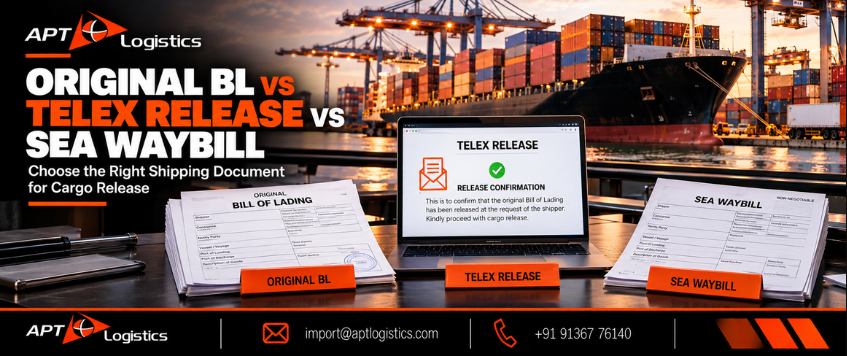
Original BL vs Telex Release vs Sea Waybill: What Is the Difference?
Choosing the right shipping document is an important part of international freight forwarding. Understanding telex release vs original BL helps exporters decide how cargo should be released at the destination and whether physical original documents are required.
An Original Bill of Lading, a telex release arrangement and a Sea Waybill can all support cargo transportation, but they differ in document handling, cargo release procedures and control over the shipment.
The right option depends on the commercial agreement, payment terms, carrier procedures and the requirements of the importer.
1. What Is an Original Bill of Lading?
An Original Bill of Lading (Original BL) is a physical transport document issued in original form by the carrier or an authorized party.
When issued as a negotiable bill of lading, it can serve as a document of title. The carrier generally requires presentation of the properly endorsed original B/L, subject to its terms and applicable procedures, before releasing the cargo.
When Is an Original BL Used?
Exporters may use an Original BL when:
-
The buyer and seller require documentary control over the cargo.
-
Payment arrangements depend on presentation of shipping documents.
-
A bank or letter of credit requires original transport documents.
-
The transaction requires a negotiable document of title.
Important: Not every Bill of Lading is negotiable. The document’s wording and type determine its legal characteristics.
2. What Is a Telex Release?
A telex release is a carrier’s instruction or confirmation to its destination office or agent that cargo may be released without presentation of the original B/L, subject to the carrier’s procedures and other release requirements.
It is commonly arranged when the original negotiable B/L has been surrendered to the issuing carrier or authorized party at origin.
How Does a Telex Release Work?
-
The exporter requests a surrender or telex release arrangement.
-
The required original B/Ls are surrendered when applicable.
-
The carrier records the surrender and authorizes release.
-
The destination office receives the release confirmation.
-
The importer completes the applicable payment, customs and cargo-release formalities.
Benefits of Telex Release
-
Avoids couriering original B/Ls to the destination.
-
Can reduce delays caused by documents arriving late.
-
Simplifies document handling for suitable transactions.
-
Is useful for established buyer-seller relationships.
However, exporters should confirm payment security and any banking requirements before surrendering the original B/L.
3. What Is a Sea Waybill?
A Sea Waybill is a non-negotiable transport document that evidences the contract of carriage and receipt of cargo.
Unlike a negotiable Original B/L, it generally does not function as a document of title. The carrier typically releases the cargo to the named consignee after verifying identity and satisfying the applicable release requirements, without requiring presentation of an original negotiable B/L.
When Is a Sea Waybill Suitable?
A Sea Waybill may be suitable when:
-
The buyer and seller have an established commercial relationship.
-
Transfer of the document by endorsement is unnecessary.
-
The transaction does not require a negotiable B/L.
-
The carrier and any relevant banks accept the arrangement.
A Sea Waybill should not be selected without checking the sales contract, payment terms and documentary requirements.
Key Differences: Original BL vs Telex Release vs Sea Waybill
Factor Original BL Telex Release Sea Waybill Document format Original document issued Release instruction linked to a B/L Non-negotiable transport document Original presentation at destination Generally required for negotiable B/L Generally not required after authorized release Generally not required Negotiable document of title Can be, depending on B/L type Depends on the underlying B/L; surrender affects release control No Courier of originals Often required Usually avoided after surrender Usually avoided Cargo release Against required original B/L and other formalities Based on carrier’s release confirmation and other formalities Based on carrier verification and other formalities Best suited for Transactions requiring documentary control Suitable shipments where original B/Ls are surrendered Transactions not requiring a negotiable B/L Telex Release vs Original BL: Which Should Exporters Choose?
The decision should be based on the shipment’s commercial and documentary requirements, not simply on speed.
Choose an Original BL when negotiability, documentary control or a bank’s requirements make it necessary.
Consider a telex release when an Original BL has been issued but the parties agree to surrender it and the carrier authorizes destination release without physical presentation.
Consider a Sea Waybill when a non-negotiable transport document is appropriate from the outset and the transaction does not require an Original BL.
Before confirming the arrangement, verify the payment terms, letter-of-credit conditions, carrier procedures and destination requirements.
Common Mistakes to Avoid
-
Requesting a telex release before confirming payment security.
-
Assuming every Original BL is negotiable.
-
Confusing a telex release with a Sea Waybill.
-
Ignoring bank or letter-of-credit document requirements.
-
Assuming cargo release is automatic after document surrender.
-
Failing to confirm outstanding freight, customs and destination formalities.
How APT Logistics Supports Shipping Documentation
At APT Logistics, our team coordinates with shipping lines, overseas agents and customers to manage Original B/L, surrendered B/L, telex release and Sea Waybill requirements.
We verify document instructions, consignee details and applicable carrier procedures to help reduce avoidable release delays.
Our objective is to ensure that the chosen documentation arrangement aligns with the shipment’s commercial requirements and the applicable release process.
Conclusion
Understanding telex release vs original BL is essential for exporters who want to balance cargo-release efficiency with appropriate documentary control.
An Original BL may provide negotiability and control, a telex release allows cargo to be released without physical presentation after an authorized surrender arrangement, and a Sea Waybill provides a non-negotiable alternative.
The correct choice depends on the transaction, payment terms and carrier requirements.
APT Logistics — Reliable Export Documentation and International Freight Solutions.
-
Need Help? Chat with us!
Start a Conversation
Hi! Click one of our members below to chat on WhatsApp