-

12
Oct
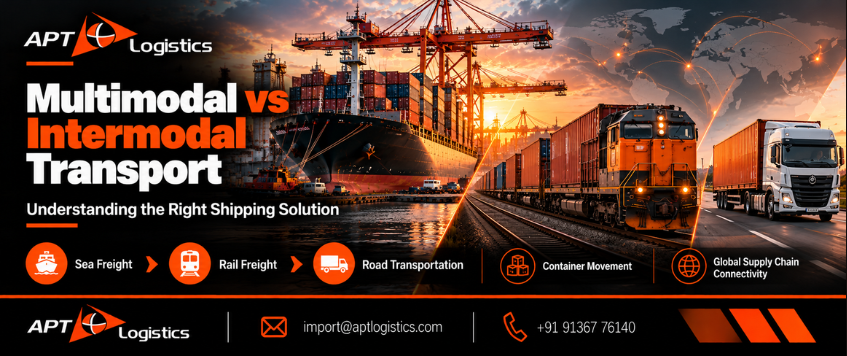
Multimodal vs Intermodal Transport: Key Differences
What Is the Difference Between Multimodal and Intermodal Transportation?
International shipments often travel by more than one mode of transport. Cargo may move by truck to a port, by sea to another country and then by rail or road to its final destination.
Understanding multimodal vs intermodal transport helps exporters and importers choose the right shipping arrangement based on cost, transit time, documentation and operational control.
Although both methods combine multiple transport modes, the key difference is generally how the transportation is contracted and managed.
What Is Multimodal Transportation?
Multimodal transportation uses two or more modes of transport—such as road, rail, sea or air—under a single multimodal transport contract, typically managed by one multimodal transport operator.
For example, an Indian exporter may move machinery from a factory in Pune by road to Nhava Sheva, ship it by sea to Europe and arrange onward trucking to the buyer’s warehouse under one coordinated transport arrangement.
The operator may assume contractual responsibility for the overall movement, subject to the applicable contract and liability rules.
Benefits of Multimodal Transport
-
Single point of coordination: One operator coordinates the overall transportation arrangement.
-
Simplified administration: A single contract or transport document may cover the journey.
-
Better shipment visibility: Coordinated planning can improve communication between transport stages.
-
Integrated logistics: Road, rail, sea and air services can be combined to suit the shipment.
What Is Intermodal Transportation?
Intermodal transportation also uses two or more modes of transport, but the cargo generally remains in the same loading unit—such as a container—while moving between modes.
The transport legs may be arranged under separate contracts with different carriers or service providers.
For example, a container may travel by truck from a factory in India to a rail terminal, continue by rail to a port, move by sea to an overseas port and then travel by truck to the consignee.
The container stays intact through the different stages, reducing the need to unload and reload the individual cargo.
Benefits of Intermodal Transport
-
Reduced cargo handling: The same container can move between transport modes.
-
Flexible carrier selection: Different providers can be selected for individual transport legs.
-
Potential cost efficiency: Rail and sea transport can be economical for suitable long-distance routes.
-
Improved cargo protection: Keeping cargo in a sealed container can reduce handling exposure, although it does not eliminate damage risks.
Multimodal vs Intermodal Transport: Key Differences
Factor Multimodal Transport Intermodal Transport Transport modes Two or more Two or more Contract structure Typically one overall transport contract May involve separate contracts for different legs Main responsibility Often one multimodal transport operator May be divided among carriers Documentation May use one multimodal transport document May use separate documents for each leg Cargo handling Depends on the arrangement Cargo usually stays in the same loading unit Coordination Centralized under one operator Can require coordination across several providers Important: These terms can overlap in practical logistics. Multimodal transport focuses on the contractual and operational arrangement, while intermodal transport commonly emphasizes the use of the same loading unit across different modes. The exact distinction depends on the applicable transport framework and contract.
Which Transport Method Should Exporters Choose?
The right option depends on the cargo, route, budget and delivery requirements.
Choose Multimodal Transport When:
-
You want one operator to coordinate the complete journey.
-
Your shipment needs integrated road, rail, sea or air services.
-
You prefer centralized communication and documentation.
-
You need a coordinated door-to-door logistics solution.
Choose Intermodal Transport When:
-
Cargo can remain in the same container across transport modes.
-
Your route has suitable rail, sea and road connections.
-
You want flexibility to select providers for different legs.
-
Reducing cargo handling is an important priority.
Before making a decision, compare the total logistics cost, transit time, transfer points, insurance, customs requirements and responsibility for delays or cargo damage.
How APT Logistics Supports Multimodal and Intermodal Shipping
At APT Logistics, we coordinate international freight solutions involving sea freight, air freight, inland transportation, container handling and destination delivery.
Our team evaluates cargo dimensions, destination, transit requirements and available routes to identify a suitable transport arrangement. We also coordinate documentation, customs clearance and communication between the relevant logistics partners.
Whether your shipment requires a coordinated multimodal solution or container-based intermodal movement, the objective is to achieve a practical balance between cost, transit time and operational reliability.
Conclusion
Understanding multimodal vs intermodal transport helps businesses plan international shipments more effectively.
Multimodal transportation generally focuses on managing multiple transport modes under one overall contract, while intermodal transportation commonly involves moving the same loading unit between modes, potentially under separate contracts.
The best solution depends on the route, cargo type, cost, delivery schedule and level of coordination required.
APT Logistics — Integrated Freight Solutions from India to Global Markets.
Frequently Asked Questions
1. What is the main difference between multimodal and intermodal transport?
Multimodal transport generally involves one overall transport contract covering multiple modes. Intermodal transport commonly moves cargo in the same loading unit between different modes, potentially using separate contracts.
2. Is intermodal transportation always cheaper?
No. Costs depend on route availability, terminal handling, transfer charges, distance, equipment and transit time. A complete cost comparison is necessary.
3. Can one container be used for intermodal transport?
Yes. Containers are commonly used because they can be transferred between ships, trains and trucks without unloading the cargo itself.
4. Is door-to-door shipping multimodal?
It can be. A door-to-door shipment using road and sea transport, for example, may be arranged under a single multimodal contract or through separate transport contracts.
5. Which is better for international exports from India?
Neither is universally better. Exporters should compare the available route, freight cost, transit time, cargo requirements and contractual responsibilities before choosing.
-
Need Help? Chat with us!
Start a Conversation
Hi! Click one of our members below to chat on WhatsApp