-

08
May
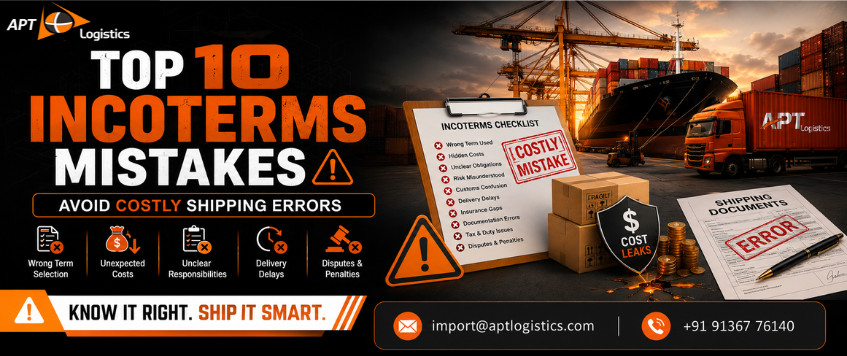
Top 10 Incoterms Mistakes to Avoid in International Shipping
Top 10 Incoterms Mistakes to Avoid
Incoterms play a major role in international trade by defining shipping responsibilities, costs, and risk transfer between buyers and sellers. However, many businesses misunderstand these terms, leading to delays, disputes, unexpected costs, and supply chain issues.
Understanding the most common Incoterms mistakes can help importers and exporters avoid expensive logistics problems and improve shipment efficiency.
1. Choosing the Wrong Incoterm ❌
Many businesses select shipping terms based only on familiarity rather than operational suitability.
For example:
- Using FOB for air freight
- Using EXW without understanding export obligations
Choosing the wrong term can increase cost and confusion.
2. Not Understanding Risk Transfer ⚠️
One of the biggest errors is misunderstanding when risk transfers from seller to buyer.
Examples:
- FOB/CFR/CIF → Risk transfers once goods are loaded onto vessel
- FCA/CPT/CIP → Risk transfers at carrier handover
Many assume risk transfers at final destination, which is incorrect.
3. Ignoring Hidden Destination Charges 💰
Terms like CIF may appear cheaper initially, but buyers often overlook:
- Destination handling charges
- Import duties
- Port storage fees
- Delivery order charges
This can significantly increase total landed cost.
4. Using FOB for Container Shipments 📦
FOB is traditionally suited for non-containerized sea cargo.
For container shipments, FCA is often more appropriate because cargo is handed to the carrier before vessel loading.
5. Confusing DAP and DDP
Businesses frequently misunderstand customs responsibilities between these two terms.
- DAP → Buyer handles import duties and taxes
- DDP → Seller handles everything including duties
This confusion often leads to customs delays and payment disputes.
6. Not Specifying the Exact Delivery Location 📍
Terms like FCA, CPT, DAP, and DDP require clearly defined delivery points.
Vague locations can create:
- Responsibility disputes
- Unexpected trucking costs
- Delivery delays
Always specify the exact place in contracts.
7. Ignoring Insurance Requirements 🛡️
Many businesses assume insurance is automatically included.
In reality:
✔ Insurance included only in CIP and CIF
❌ Not included in FOB, FCA, CFR, CPT, DAP, or DDPLack of insurance can result in major financial losses.
8. Assuming Seller Handles Export Clearance Everywhere 📄
Under EXW, the buyer is responsible for export clearance.
However, in many countries, export formalities must legally be handled by the seller, making EXW impractical in certain cases.
9. Focusing Only on Freight Cost
Many importers compare only freight rates without evaluating:
- Duties and taxes
- Local delivery costs
- Risk exposure
- Insurance coverage
The cheapest quote is not always the most cost-effective option.
10. Not Reviewing Incoterms Version
Incoterms are updated periodically by the ICC.
Using outdated versions can create confusion in contracts and responsibilities.
Always specify:
👉 Incoterms® 2020
This ensures clarity and modern compliance.
Why These Mistakes Matter
Incorrect use of shipping terms can lead to:
- Shipment delays
- Unexpected charges
- Insurance disputes
- Customs issues
- Supply chain disruptions
Proper understanding reduces operational risk and improves shipping efficiency.
How APT Logistics Helps
APT Logistics supports businesses with:
- Incoterm consultation
- Cost and risk analysis
- Freight planning
- Customs clearance support
- End-to-end logistics management
We help businesses avoid costly shipping errors and improve global trade operations.
Conclusion
Avoiding common Incoterms mistakes is essential for smooth international shipping. Understanding responsibilities, risk transfer, and cost structure helps businesses make smarter logistics decisions.
With APT Logistics, you get expert guidance and reliable support for efficient global cargo movement.
Need Help? Chat with us!
Start a Conversation
Hi! Click one of our members below to chat on WhatsApp