-

05
May
CIF vs DDP Cost Comparison | Which Shipping Term is Better?
CIF vs DDP Cost Comparison | APT Logistics
In international shipping, selecting the right Incoterm directly impacts your total landed cost, risk, and operational control. Two commonly compared terms are CIF (Cost, Insurance, and Freight) and DDP (Delivered Duty Paid). This guide explains the CIF vs DDP cost comparison in detail, helping businesses make informed logistics decisions.
What is CIF?
Under CIF, the seller covers:
- Cost of goods
- Ocean freight
- Basic insurance
The seller’s responsibility ends at the destination port, while the buyer handles import clearance, duties, and delivery.
What is DDP?
Under DDP, the seller handles:
- Transportation (origin to destination)
- Export and import customs clearance
- Duties and taxes
- Final delivery
This makes DDP a complete door-to-door solution.
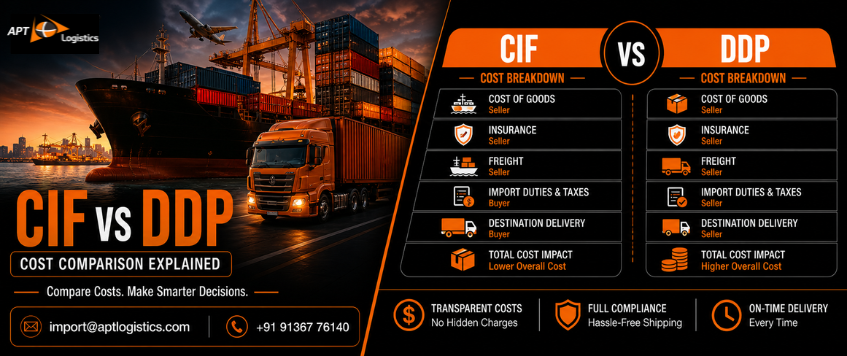
CIF vs DDP Cost Comparison
The major difference lies in who pays for what.
Cost Component CIF DDP Product Cost Seller Seller Export Charges Seller Seller Ocean Freight Seller Seller Insurance Seller (basic) Seller (optional) Import Duties & Taxes Buyer Seller Destination Charges Buyer Seller Final Delivery Buyer Seller Total Cost Visibility Partial Full
Understanding Total Landed Cost
CIF Cost Perspective 💰
CIF appears cheaper initially because it excludes:
- Import duties
- Destination handling charges
- Last-mile delivery
However, these costs are later borne by the buyer, often leading to unexpected expenses.
DDP Cost Perspective 💰
DDP includes all costs upfront, such as:
- Duties and taxes
- Customs clearance
- Delivery to final location
Although the upfront price is higher, it provides complete cost clarity.
Key Cost Differences Explained
1. Upfront vs Hidden Costs
- CIF: Lower initial price, higher hidden costs
- DDP: Higher initial price, minimal surprises
2. Control Over Expenses
- CIF: Buyer controls import costs
- DDP: Seller controls entire cost structure
3. Risk and Responsibility ⚠️
- CIF: Risk transfers at port of origin
- DDP: Risk remains with seller until delivery
4. Insurance Coverage
- CIF: Basic insurance included
- DDP: Insurance optional but often included
When is CIF More Cost-Effective?
CIF works best when:
- Buyer has strong import experience
- Buyer can negotiate local charges
- Buyer wants control over costs
- Shipment is bulk or regular
When is DDP More Cost-Effective?
DDP is ideal when:
- Buyer wants a hassle-free experience
- Buyer is unfamiliar with import regulations
- Shipment is small or time-sensitive
- Cost predictability is important
Real-World Insight
Many businesses initially choose CIF due to lower quoted rates but later face:
- High port charges
- Unexpected customs costs
- Delays in clearance
DDP, while more expensive upfront, often reduces operational complexity and risk.
Common Mistakes to Avoid
- Comparing only freight rates
- Ignoring destination charges
- Not calculating total landed cost
- Underestimating customs duties
A complete cost analysis is essential.
How APT Logistics Helps
APT Logistics helps businesses evaluate the right option with:
- Detailed cost comparison
- Transparent pricing breakdown
- Import clearance expertise
- End-to-end logistics solutions
- Risk and cost optimization
We ensure you choose the most efficient and cost-effective shipping strategy.
Conclusion
Understanding the CIF vs DDP cost comparison is essential for accurate budgeting and efficient logistics planning. While CIF offers lower upfront costs and flexibility, DDP provides convenience and full cost transparency.
With APT Logistics, you can analyze both options and choose the best fit for your business needs.
Need Help? Chat with us!
Start a Conversation
Hi! Click one of our members below to chat on WhatsApp