-

06
May
FOB vs FCA | Key Differences in Shipping Terms Explained | APT Logistics
FOB vs FCA | Complete Guide for Shippers
In international trade, selecting the right Incoterm is essential for controlling cost, risk, and shipping responsibility. Two commonly used terms are FOB (Free On Board) and FCA (Free Carrier). While both are widely used in exports, there are important differences between them.
This guide explains FOB vs FCA in detail, including shipping process, risk transfer, transport suitability, and which option works best for different types of cargo.
What is FOB?
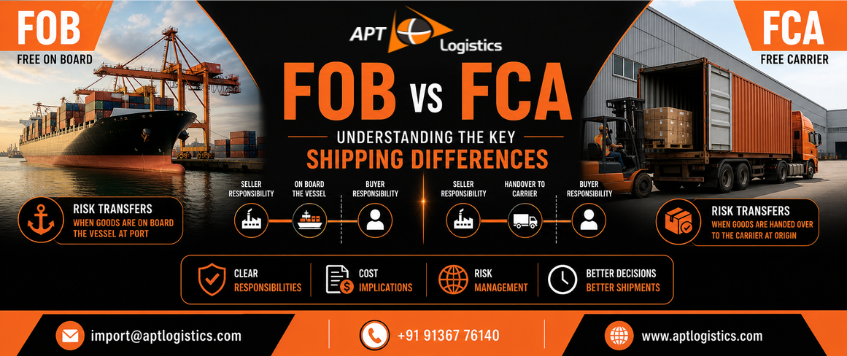
FOB (Free On Board) is an Incoterm mainly used for sea freight. Under this term, the seller is responsible for delivering goods onto the vessel at the port of shipment.
Once the cargo is loaded onto the ship, the risk transfers to the buyer.
Seller Responsibilities Under FOB
- Inland transport to port
- Export customs clearance
- Port handling and vessel loading
Buyer Responsibilities Under FOB
- Ocean freight
- Insurance
- Import clearance
- Final delivery
What is FCA?
FCA (Free Carrier) is a more flexible Incoterm that can be used for all transport modes, including air, road, rail, and sea.
Under this term, the seller delivers goods to a carrier or a specified location chosen by the buyer.
Risk transfers once the goods are handed over to the carrier.
Seller Responsibilities Under FCA
- Cargo preparation and packaging
- Export customs clearance
- Delivery to carrier or named place
Buyer Responsibilities Under FCA
- Main freight transportation
- Insurance
- Import clearance
- Final delivery
FOB vs FCA Comparison Table
Factor FOB FCA Full Form Free On Board Free Carrier Suitable For Sea freight only All transport modes Risk Transfer On vessel loading At carrier handover Export Clearance Seller Seller Freight Arrangement Buyer Buyer Flexibility Moderate High Container Shipment Suitability Less ideal More suitable
Key Differences Explained
1. Mode of Transport 🚢✈️
FOB is designed only for sea and inland waterway transport.
FCA works for:
- Air freight
- Sea freight
- Road transport
- Rail transport
- Multimodal shipments
This makes FCA more versatile.
2. Risk Transfer Point ⚠️
Under FOB:
👉 Risk transfers once cargo is loaded onto the vessel.
Under FCA:
👉 Risk transfers once goods are handed over to the carrier.
This is one of the biggest differences between the two terms.
3. Container Shipping Suitability 📦
FCA is generally preferred for containerized cargo because containers are usually handed to carriers before vessel loading.
FOB is more suitable for traditional port-based bulk or non-container cargo.
4. Logistics Coordination
FOB involves more coordination at the port level.
FCA simplifies the process because the seller’s responsibility ends earlier.
When Should You Use FOB?
FOB is ideal when:
- Shipment is via sea freight
- Cargo is non-containerized
- Buyer wants control over ocean freight
- Port loading process is clearly defined
ALSO READ | FOB Explained
When Should You Use FCA?
FCA is suitable when:
- Shipment uses multiple transport modes
- Cargo is containerized
- Buyer wants flexibility
- Air freight is involved
ALSO READ | FCA Explained
Common Mistakes to Avoid
- Using FOB for air freight
- Confusing vessel loading with carrier handover
- Not specifying exact delivery point under FCA
- Ignoring risk transfer timing
Understanding these details helps avoid disputes and unexpected costs.
How APT Logistics Helps
APT Logistics helps businesses select the right shipping terms with:
- Freight planning and coordination
- Export customs clearance
- Air and sea freight solutions
- Risk and cost analysis
- End-to-end logistics management
We ensure smooth cargo movement under both FOB and FCA arrangements.
Conclusion
Understanding FOB vs FCA is important for efficient shipping and better cost control. While FOB remains popular for sea freight, FCA offers greater flexibility and is often better suited for modern containerized logistics.
With APT Logistics, businesses can choose the right Incoterm and ensure reliable international shipping operations.
Need Help? Chat with us!
Start a Conversation
Hi! Click one of our members below to chat on WhatsApp