-

11
May
Risk Transfer in Shipping Explained | When Responsibility Changes
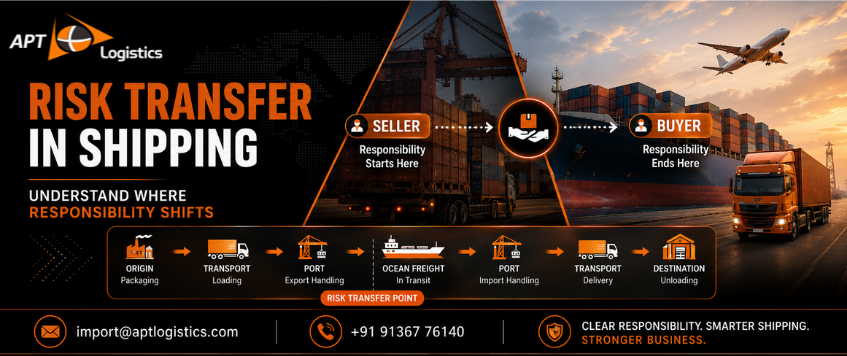
Risk Transfer in Shipping | Where Responsibility Shifts
In international trade, one of the most important concepts businesses must understand is risk transfer in shipping. Many importers and exporters assume that responsibility changes when goods arrive at destination — but in reality, risk often transfers much earlier.
Understanding exactly where responsibility shifts can help businesses avoid disputes, insurance issues, and unexpected financial losses.
What is Risk Transfer in Shipping?
Risk transfer refers to the point at which responsibility for cargo loss, damage, or delay moves from the seller to the buyer.
This transfer point is determined by the agreed Incoterm used in the shipment contract.
Once the risk shifts:
✔ The buyer becomes responsible for cargo safety
✔ Insurance claims become the buyer’s responsibility
✔ Financial loss risk transfers to the buyerThis makes understanding shipping terms extremely important.
Why Risk Transfer Matters
Incorrect assumptions about responsibility can lead to:
🚫 Insurance disputes
🚫 Unexpected financial losses
🚫 Delays in cargo claims
🚫 Confusion between buyers and sellersFor example, many buyers believe the seller remains responsible until final delivery — which is not always true.
Risk Transfer Under Common Incoterms
EXW (Ex Works) ⚠️
Under EXW:
👉 Risk transfers at the seller’s premises.
As soon as goods are made available for pickup, the buyer assumes responsibility.
This gives maximum responsibility to the buyer.
FCA (Free Carrier)
Under FCA:
👉 Risk shifts when goods are handed over to the carrier.
This usually occurs at:
- Warehouse
- Terminal
- Airport cargo station
- Container yard
FCA is commonly used for air freight and containerized shipments.
FOB (Free On Board) 🚢
Under FOB:
👉 Responsibility transfers once goods are loaded onto the vessel.
This means the seller is responsible until cargo is physically on board the ship.
FOB is widely used in sea freight.
CFR and CIF
Both CFR and CIF follow the same transfer point as FOB.
👉 Risk transfers at vessel loading — not at destination port.
Even though the seller pays freight charges, the buyer bears transit risk after loading.
This is one of the most misunderstood areas in global shipping.
CPT and CIP ✈️
Under CPT and CIP:
👉 Risk transfers once goods are handed to the first carrier.
In CIP, insurance is included, but the buyer still bears risk after handover.
DAP (Delivered At Place)
Under DAP:
👉 Risk remains with the seller until cargo arrives at the agreed destination, ready for unloading.
The buyer takes responsibility before unloading begins.
DDP (Delivered Duty Paid)
DDP offers maximum seller responsibility.
👉 Risk transfers only after goods are delivered to the buyer’s destination.
The seller manages nearly the entire logistics process.
Risk Transfer Comparison Table
Incoterm Risk Transfer Point EXW Seller premises FCA Carrier handover FOB Loaded on vessel CFR Loaded on vessel CIF Loaded on vessel CPT First carrier CIP First carrier DAP Destination before unloading DDP Final delivery
Common Mistakes Businesses Make
1. Assuming Freight Payment = Risk Responsibility
Many buyers think:
👉 “If seller pays freight, seller carries the risk.”
This is incorrect in terms like CFR and CIF.
2. Ignoring Insurance Needs 🛡️
Some Incoterms do not include insurance.
Without proper coverage, businesses may face major financial loss.
3. Not Defining Delivery Points Clearly
Unclear handover locations create disputes about responsibility.
Always specify exact delivery locations in contracts.
How to Reduce Risk in International Shipping
✔ Choose the right Incoterm
✔ Understand transfer points clearly
✔ Use cargo insurance
✔ Work with experienced logistics partners
✔ Maintain proper documentationThese steps help minimize operational and financial risk.
How APT Logistics Helps
APT Logistics helps businesses manage shipping risk through:
✔ Incoterm consultation
✔ Cargo insurance guidance
✔ Freight planning and coordination
✔ Real-time shipment tracking
✔ End-to-end logistics supportWe ensure clarity, transparency, and smooth cargo movement across global supply chains.
Conclusion
Understanding risk transfer in shipping is essential for avoiding costly mistakes in international trade. Different Incoterms transfer responsibility at different stages, making it critical for buyers and sellers to clearly understand their obligations.
With APT Logistics, businesses can confidently manage cargo movement, reduce risk exposure, and optimize global shipping operations.
Need Help? Chat with us!
Start a Conversation
Hi! Click one of our members below to chat on WhatsApp