-

24
Nov
Import and Export Cargo Handling at Mundra Port | APT Logistics
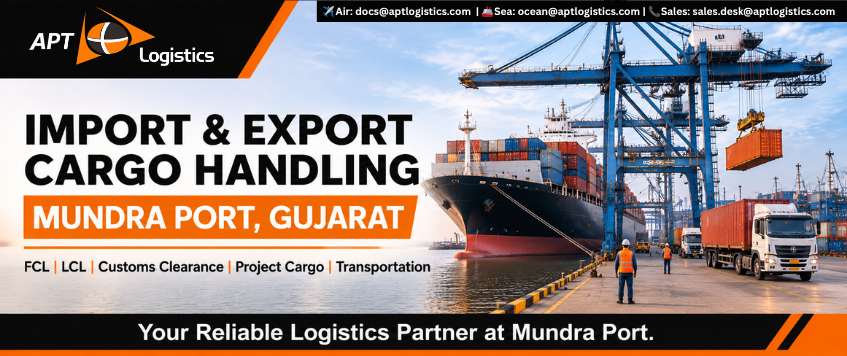
Import and Export Cargo Handling at Mundra Port
Efficient import and export cargo handling at Mundra Port plays an important role in India’s international trade. Located in Gujarat, Mundra is a major maritime gateway connecting Indian manufacturers, exporters and importers with global markets. Businesses use the port for containerised shipments, bulk commodities, industrial machinery, project cargo, liquid cargo and other commercial goods.
For importers and exporters, successful cargo movement requires more than vessel booking. It involves coordinating cargo receiving, documentation, customs clearance, terminal handling, container movement and inland transportation.
APT Logistics provides integrated freight forwarding and logistics support for businesses managing international shipments through Mundra Port.
Why Is Mundra Port Important for Cargo Handling?
Mundra Port is operated by Adani Ports and Special Economic Zone (APSEZ). Its infrastructure supports containerised, dry bulk, liquid, breakbulk, project and automobile cargo operations.
The port has multimodal connectivity through road, rail, pipelines and other cargo evacuation systems. Its facilities include container terminals, multipurpose berths, covered warehouses, open storage yards and specialised cargo-handling infrastructure.
India’s largest commercial port+1
These capabilities make Mundra an important logistics gateway for businesses in Gujarat and the northern and north-western Indian hinterland.
Import Cargo Handling at Mundra Port
Import cargo handling involves several coordinated activities from vessel arrival to final delivery.
1. Vessel Arrival and Cargo Discharge
When the vessel arrives, the shipping line or its authorised agent completes the applicable manifest formalities. Cargo is discharged and transferred to the designated terminal or storage area.
2. Import Documentation
The importer or authorised customs broker arranges the required documentation, which may include:
-
Commercial invoice
-
Packing list
-
Bill of Lading
-
Bill of Entry
-
Import licences or certificates, where applicable
-
Certificate of Origin, where required
3. Customs Clearance
The Bill of Entry is filed through the customs electronic system. Customs assessment, duty payment and examination requirements are completed as applicable.
4. Cargo Release and Transportation
After customs clearance and applicable terminal and shipping-line release formalities, the cargo can be arranged for delivery through road or rail transportation.
Mundra also has container freight station facilities supporting import storage, examination, de-stuffing and transportation coordination.
Export Cargo Handling at Mundra Port
Export cargo handling requires proper coordination before the goods reach the terminal.
The general process includes:
-
Cargo readiness confirmation at the factory or warehouse.
-
Container booking and equipment arrangement.
-
Factory stuffing or cargo delivery to the designated facility.
-
Preparation of invoice, packing list and shipping instructions.
-
Shipping Bill filing and applicable customs formalities.
-
Customs examination, if ordered, and completion of export clearance.
-
Terminal gate-in and compliance with shipping-line cut-offs.
-
Vessel loading and shipment departure.
Accurate documentation and timely cargo delivery are important for avoiding missed vessel connections and additional operational costs.
Types of Cargo Handled at Mundra Port
Mundra supports different categories of import and export cargo, including:
Cargo Category Examples Containerised Cargo General merchandise, electronics and engineering goods Dry Bulk Cargo Coal, minerals and agricultural commodities Breakbulk Cargo Steel, industrial materials and machinery Project Cargo Transformers, generators and oversized equipment Liquid Cargo Petroleum products, chemicals and edible oils Automobile Cargo Cars, buses and commercial vehicles The appropriate terminal, equipment and handling procedure depend on the commodity and shipment requirements.
Common Challenges in Import and Export Cargo Handling
Businesses may experience operational difficulties such as:
-
Delays in customs documentation or examination.
-
Incorrect cargo declarations and HS code classification.
-
Container availability and equipment mismatches.
-
Missed vessel cut-off timings.
-
Port storage, demurrage and detention charges.
-
Delays in transportation and cargo evacuation.
-
Special handling requirements for oversized or sensitive cargo.
Advance shipment planning and coordination between the freight forwarder, customs broker, transporter, shipping line and terminal can help reduce avoidable delays.
Why Choose APT Logistics for Cargo Handling at Mundra Port?
APT Logistics provides freight forwarding solutions for importers, exporters, manufacturers and trading companies handling cargo through major Indian ports.
Our services include:
-
FCL and LCL ocean freight.
-
Import and export customs clearance coordination.
-
Inland transportation and door delivery.
-
Project cargo and OOG shipment coordination.
-
Open Top and Flat Rack container arrangements.
-
Breakbulk and heavy equipment handling.
-
Warehousing and cargo distribution.
-
Air freight import and export services.
Whether you are importing industrial machinery, exporting commercial goods or moving specialised project cargo, APT Logistics can assist with freight coordination, documentation and transportation planning according to your shipment requirements.
Frequently Asked Questions (FAQs)
1. What types of cargo are handled at Mundra Port?
Mundra handles containerised cargo, dry bulk, liquid cargo, breakbulk, project cargo, automobiles, steel and other commercial commodities.
2. What documents are required for import cargo handling?
Common documents include the commercial invoice, packing list, Bill of Lading, Bill of Entry and applicable licences or certificates.
3. What is the process for export cargo handling at Mundra Port?
The general process includes cargo preparation, container booking, Shipping Bill filing, customs clearance, terminal gate-in and vessel loading.
4. Can Mundra Port handle oversized and project cargo?
Yes. Mundra has infrastructure for oversized and overweight project cargo, subject to equipment, terminal, vessel and handling requirements.
5. Does APT Logistics provide transportation from Mundra Port?
APT Logistics can coordinate inland transportation for import and export cargo, subject to cargo details, destination and operational requirements.
APT Logistics – Contact Details
For import and export cargo handling, ocean freight rates, customs clearance and transportation arrangements at Mundra Port, contact our team.
Department Email Contact Number Air Freight docs@aptlogistics.com +91 79776 10560 Sea Freight ocean@aptlogistics.com +91 99200 20978 Sales sales.desk@aptlogistics.com / sea@aptlogistics.com +91 7700 914 388 Documentation cs1@aptlogistics.com +91 91367 76040 Import cs02@aptlogistics.com +91 9321740903 -
Need Help? Chat with us!
Start a Conversation
Hi! Click one of our members below to chat on WhatsApp