-

15
Jul
How to Avoid Customs Holds | Logistics Tip
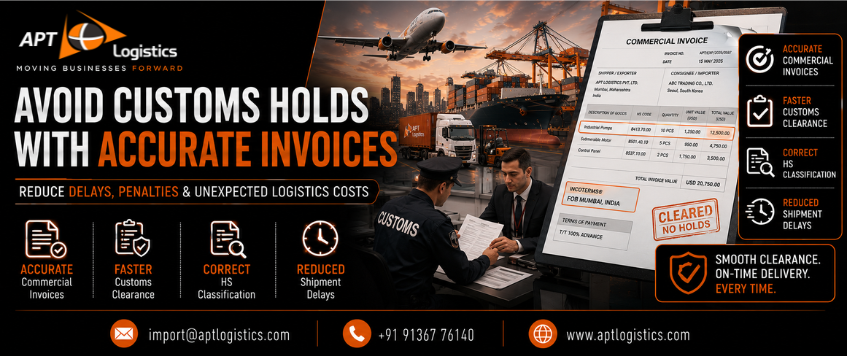
Logistics Tip: Avoid Customs Holds with Accurate Invoices
One of the simplest ways to avoid customs holds with accurate invoices is by ensuring that every commercial invoice contains complete, correct, and consistent information. Customs authorities worldwide rely on commercial invoices to determine cargo value, product classification, duties, taxes, and compliance requirements.
Even a minor documentation error can trigger customs inspections, shipment delays, additional charges, or cargo holds that disrupt supply chains and increase logistics costs.
Why Commercial Invoices Matter
The commercial invoice is one of the most important documents in international shipping.
Customs authorities use it to verify:
- Cargo description
- Product value
- Quantity shipped
- Country of origin
- Buyer and seller information
- Applicable duties and taxes
An inaccurate invoice can create immediate concerns for customs officers and lead to further scrutiny.
Common Invoice Mistakes That Cause Customs Holds
Many customs delays occur due to preventable documentation errors.
Common mistakes include:
- Incomplete product descriptions
- Incorrect cargo values
- Missing HS codes
- Quantity mismatches
- Incorrect Incoterms
- Missing shipper or consignee details
- Discrepancies between packing list and invoice
- Currency declaration errors
Examples of Poor Product Descriptions
Incorrect
- Spare Parts
- Chemicals
- Machinery
- Electronics
Better Descriptions
- Automotive Brake Pads – HS Code XXXXX
- Industrial Lubricant Additive
- CNC Milling Machine Components
- Printed Circuit Boards for Industrial Equipment
Detailed descriptions help customs officials classify cargo accurately.
Consequences of Customs Holds
When customs identifies invoice discrepancies, businesses may face:
- Shipment delays
- Physical inspections
- Storage charges
- Demurrage and detention costs
- Customs penalties
- Customer dissatisfaction
- Supply chain disruptions
In severe cases, cargo may be detained until documentation issues are resolved.
Best Practices for Accurate Commercial Invoices
To reduce customs risks:
- Use detailed product descriptions
- Declare correct cargo values
- Verify quantities and weights
- Include accurate HS codes
- Confirm Incoterms before shipment
- Match invoice details with packing lists
- Ensure consignee information is correct
- Review documentation before cargo dispatch
The Role of HS Codes
HS (Harmonized System) Codes are critical for customs classification.
Benefits of accurate HS codes include:
- Faster customs clearance
- Correct duty assessment
- Reduced inspection risk
- Improved compliance
- Fewer shipment disputes
Incorrect classification can lead to customs queries and financial penalties.
APT Logistics Insight ⭐
Many businesses focus heavily on freight rates and transit times but underestimate the importance of documentation quality. In reality, customs documentation errors are among the leading causes of shipment delays worldwide.
A properly prepared commercial invoice often prevents far more costs than it creates.
How APT Logistics Helps Prevent Customs Delays
APT Logistics supports importers and exporters with:
- Documentation review
- Commercial invoice verification
- HS code guidance
- Customs clearance support
- Export documentation assistance
- Compliance checks
- End-to-end logistics coordination
Our experienced team helps businesses reduce customs risks and improve shipment reliability.
Conclusion
Businesses that avoid customs holds with accurate invoices can significantly reduce delays, lower logistics costs, and improve supply chain performance. A well-prepared commercial invoice not only supports faster customs clearance but also helps prevent inspections, penalties, and unexpected expenses.
At APT Logistics, we help clients prepare accurate shipping documentation to ensure smooth cargo movement across global markets.
FAQ
Why do customs authorities inspect invoices?
Customs authorities use invoices to verify cargo value, product classification, and compliance with import regulations.
Can an incorrect invoice delay a shipment?
Yes. Even small errors can trigger customs reviews, inspections, and shipment holds.
What information should be included on a commercial invoice?
Product description, quantity, value, HS code, Incoterm, shipper details, consignee details, and country of origin.
How can businesses reduce customs clearance delays?
By ensuring accurate documentation, correct HS codes, detailed product descriptions, and consistency across all shipping documents.
Need Help? Chat with us!
Start a Conversation
Hi! Click one of our members below to chat on WhatsApp