-

16
Nov
Container Payload Calculation: Weight Limits for 20ft & 40ft Containers
How to Calculate Container Payload and Cargo Weight Limits
Container payload calculation helps exporters determine the maximum cargo weight that can be loaded into a container while staying within the manufacturer’s specified weight limits and applicable transportation regulations.
When planning an international sea freight shipment, understanding container weight limits is essential for safe transportation and regulatory compliance. Exporters and importers must ensure that the cargo loaded inside a shipping container does not exceed its permitted payload capacity.
Incorrect weight calculations can lead to container overloading, transportation restrictions, additional charges, and shipment delays.
Whether you are shipping a 20ft GP, 40ft GP, or 40ft High Cube container, understanding tare weight, payload, and maximum gross weight is important before arranging container stuffing.
1. What Is Container Payload?
Container payload refers to the maximum weight of cargo that can be loaded inside a shipping container.
It represents the cargo-carrying capacity of the container, excluding the container’s own empty weight.
Every shipping container has three important weight specifications:
-
Tare Weight: The empty weight of the container without cargo.
-
Payload: The maximum permitted cargo weight that can be loaded into the container.
-
Maximum Gross Weight: The maximum permitted combined weight of the container and its contents.
These values are generally displayed on the container’s CSC safety approval plate and should be checked before loading.
2. How to Calculate Container Payload?
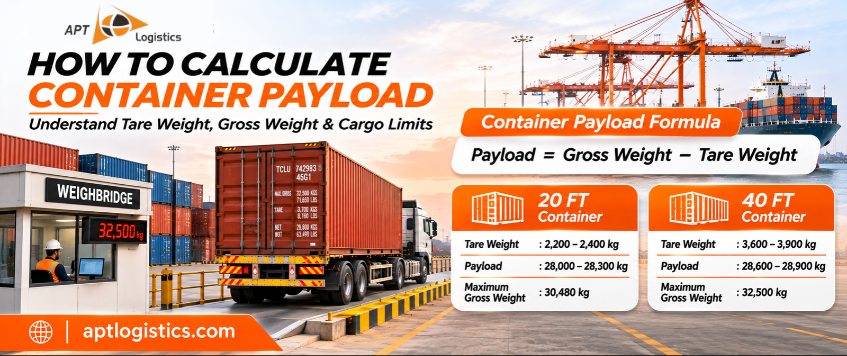
The container payload calculation uses a simple formula:
Container Payload Formula
\[ \text{Payload}=\text{Maximum Gross Weight}-\text{Tare Weight} \]All weights must be expressed in the same unit, usually kilograms.
Example:
Suppose a container has:
-
Maximum Gross Weight: 30,480 kg
-
Tare Weight: 2,200 kg
Calculation:
30,480 − 2,200 = 28,280 kg
Calculated payload: 28,280 kgThis means the container’s maximum cargo weight is 28,280 kg, subject to applicable road, rail, port, carrier, and equipment restrictions.
3. Standard Weight Limits for 20ft and 40ft Containers
The following figures are illustrative examples. Actual tare, payload, and maximum gross weight vary by manufacturer, container type, and individual equipment.
Sea Cans BC | New & Used Shipping Containers from $2,500 | Valleyview Containers20ft General Purpose (GP)-
Example tare weight: 2,200 kg
-
Example maximum gross weight: 30,480 kg
-
Example payload: 28,280 kg
-
Example tare weight: 3,800 kg
-
Example maximum gross weight: 30,480 kg
-
Example payload: 26,680 kg
40ft High Cube (HC)
-
Example tare weight: 3,900 kg
-
Example maximum gross weight: 30,480 kg
-
Example payload: 26,580 kg
Important: These are sample values, not universal container specifications. Always check the individual container’s CSC plate and the carrier’s equipment details before stuffing.
4. Difference Between Payload and Gross Weight
Many exporters confuse container payload with gross weight. However, both have different meanings.
Parameter Meaning Tare Weight Empty container weight Cargo Weight Actual weight of goods loaded Payload Maximum permitted cargo weight Gross Weight Container tare weight + cargo weight For example:
If a 20ft container has a tare weight of 2,200 kg and cargo weighing 25,000 kg:
Gross Weight = 2,200 + 25,000 = 27,200 kg
The gross weight must not exceed the container’s maximum permitted gross weight.
For Verified Gross Mass (VGM), the total must also include all applicable packing materials, pallets, dunnage, and securing materials.
5. What Is VGM and Why Is It Important?
VGM stands for Verified Gross Mass.
Under the SOLAS Convention, the shipper is responsible for providing the verified gross mass of a packed export container to the carrier and terminal in time for vessel stowage planning.
There are two approved methods of obtaining VGM:
Method 1 – Weigh the Packed Container
The entire packed container is weighed using calibrated and certified weighing equipment, as permitted under applicable requirements.
Method 2 – Calculate the Total Weight
Add together the cargo weight, packaging, pallets, dunnage, securing materials, and container tare weight using an approved and compliant calculation method.
An accurate VGM declaration is essential because a packed container without the required VGM cannot be loaded onto a vessel under SOLAS requirements.
6. Factors That Affect Container Cargo Weight Limits
Even if the container has sufficient payload capacity, other restrictions may affect the actual cargo weight that can be transported.
Road Transportation Restrictions
The maximum permitted vehicle and axle loads may restrict how much cargo can be moved by road from the factory to the port.
Port and Terminal Restrictions
Port and terminal handling equipment, operational rules, and applicable weight restrictions may influence container acceptance.
Shipping Line Restrictions
Carriers may impose equipment-specific or route-specific weight limits.
Cargo Distribution
Cargo should be distributed evenly to avoid excessive concentrated loads, poor weight distribution, and unsafe handling conditions.
Special Equipment Requirements
Open Top containers, Flat Racks, and other specialised equipment may have different payload and structural limitations.
7. Common Mistakes During Container Weight Calculation
Exporters should avoid the following mistakes:
-
Calculating cargo weight without considering container tare weight.
-
Confusing maximum gross weight with payload capacity.
-
Ignoring pallets, packaging, and dunnage.
-
Using standard container specifications instead of checking the actual CSC plate.
-
Overlooking road transportation weight restrictions.
-
Incorrectly declaring VGM.
-
Loading heavy cargo without proper weight distribution.
These mistakes can result in shipment delays, additional handling costs, safety risks, and possible regulatory issues.
8. How APT Logistics Supports Containerised Export Shipments
At APT Logistics, we understand the importance of accurate cargo planning and container selection for international shipments.
Our team supports exporters with:
-
20ft and 40ft container booking.
-
FCL and LCL export shipment arrangements.
-
Open Top and Flat Rack container coordination.
-
Heavy cargo and OOG shipment handling.
-
Export documentation and customs clearance coordination.
-
Container transportation and port movement.
-
Cargo loading and shipment coordination.
Whether you are exporting general cargo, industrial machinery, or oversized equipment, APT Logistics helps coordinate suitable freight and transportation arrangements based on shipment requirements.
Conclusion
Accurate container payload calculation is essential for safe and efficient international shipping. Exporters must understand the difference between tare weight, payload, and maximum gross weight before loading cargo into a shipping container.
Always verify the individual container’s CSC plate, carrier restrictions, road transportation limits, and VGM requirements before dispatch.
APT Logistics supports importers and exporters with containerised sea freight, specialised equipment arrangements, customs clearance coordination, and inland transportation solutions.
3. Frequently Asked Questions (FAQs)
Q1. What is the formula for container payload calculation?
Container payload = Maximum Gross Weight − Tare Weight.
Q2. How much cargo can a 20ft container carry?
It depends on the container’s individual specifications. An illustrative 20ft container with a 30,480 kg maximum gross weight and 2,200 kg tare weight has a payload of 28,280 kg.
Q3. How much cargo can a 40ft container carry?
Payload varies by container type and manufacturer. An illustrative standard 40ft container with a 30,480 kg maximum gross weight and 3,800 kg tare weight has a payload of 26,680 kg.
Q4. What is the difference between tare weight and payload?
Tare weight is the empty container’s weight, whereas payload is the maximum permitted cargo weight that can be loaded inside it.
Q5. Does VGM include container tare weight?
Yes. VGM includes the container’s tare weight, cargo, packaging, pallets, dunnage, and securing materials.
Q6. Can a container carry more than its specified payload?
No. The container must not exceed its permitted maximum gross weight or applicable transportation and equipment limits.
Q7. Where can exporters check container weight limits?
Exporters should check the container’s CSC safety approval plate, equipment specifications, and shipping line instructions before stuffing.
APT Logistics – Contact Details
For air freight, sea freight, sales, documentation, and import requirements, contact our respective teams:
Department Email Contact Number Air Freight docs@aptlogistics.com +91 79776 10560 Sea Freight ocean@aptlogistics.com +91 99200 20978 Sales sales.desk@aptlogistics.com / sea@aptlogistics.com +91 7700 914 388 Documentation cs1@aptlogistics.com +91 91367 76040 Import cs02@aptlogistics.com +91 9321740903 -
Need Help? Chat with us!
Start a Conversation
Hi! Click one of our members below to chat on WhatsApp