-

14
Nov
Port Storage vs Demurrage: Key Differences for Importers
What Is Port Storage vs Demurrage (Shipping Line)?
Understanding port storage vs demurrage is important for importers, customs brokers, and freight forwarders because confusion between these charges can lead to incorrect cost calculations, delayed payments, and unnecessary logistics expenses.
When importing goods through an international seaport, businesses may encounter several additional charges if containers are not cleared and moved out within the permitted free time. Two commonly misunderstood charges are port storage and shipping line demurrage.
Although both charges can arise when containers remain at the port beyond the permitted period, they are generally different charges imposed by different service providers.
1. What Is Port Storage?
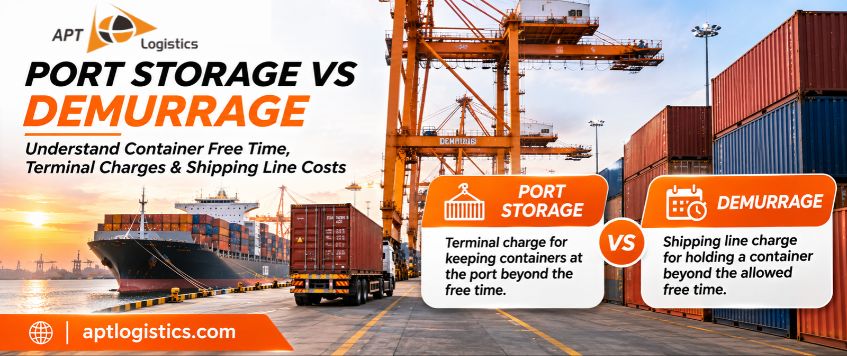
Port storage is a charge imposed by the port or terminal operator when cargo or containers remain within the terminal beyond the applicable free storage period.
When an import container arrives at a port, the terminal provides a specified period during which storage may be free of charge, depending on the terminal’s tariff and applicable conditions.
If the container is not cleared and removed within this period, storage charges may apply.
Common reasons for port storage charges:
-
Delays in customs clearance.
-
Late submission of import documentation.
-
Pending duty payment.
-
Customs examination or inspection.
-
Delayed delivery order processing.
-
Importer or transporter not arranging timely container pickup.
-
Port congestion or operational issues.
Port storage charges are generally calculated according to the terminal’s applicable tariff, container size, cargo type, and duration of storage.
2. What Is Shipping Line Demurrage?
Shipping line demurrage is a charge imposed by the shipping line when an import container remains inside the port or terminal beyond the carrier’s permitted free time.
Shipping lines provide a specified free period for importers to complete customs clearance and arrange container pickup.
If the container is not moved out of the terminal within this period, demurrage charges may become applicable according to the shipping line’s tariff or agreed contract.
Common reasons for shipping line demurrage:
-
Delayed customs clearance.
-
Import documentation discrepancies.
-
Pending regulatory approvals.
-
Delayed payment of shipping line charges.
-
Late delivery order processing.
-
Importer not arranging timely cargo evacuation.
Demurrage is generally calculated based on the container size, number of days beyond free time, and the shipping line’s applicable tariff.
3. Port Storage vs Demurrage: Key Differences
Parameter Port Storage Shipping Line Demurrage Charged by Port or terminal operator Shipping line or carrier Reason Container remains inside terminal beyond free storage time Container remains inside terminal beyond carrier free time Free time Determined by terminal tariff or applicable arrangements Determined by shipping line tariff or contract Calculation Based on terminal storage tariff Based on shipping line demurrage tariff Payment Paid to terminal or through its authorised collection process Paid to shipping line or authorised agent Main purpose Covers terminal storage of cargo or containers Compensates carrier for extended use of its container Important: Port storage and shipping line demurrage are separate charges. Depending on the port, terminal, carrier arrangement, and tariff, both may apply simultaneously to the same container.
4. Example: How Port Storage and Demurrage Can Apply Together
Consider an import container arriving at an Indian seaport.
For illustration, assume:
-
Terminal free storage: 3 days.
-
Shipping line free demurrage: 5 days.
-
Container evacuation: Day 8.
Illustrative container timeline
-
Day 1 – Container arrives
Container is discharged at the terminal.
-
Day 1–3 – Terminal free storage
No port storage charge during the assumed free period.
-
Day 4–5 – Storage may apply
Terminal free time has expired, so port storage may be charged.
-
Day 6–8 – Both charges may apply
Shipping line demurrage free time has also expired.
-
Day 8 – Container evacuated
Container moves out of the terminal, subject to clearance and release formalities.
Illustrative example only. Actual free-time start dates, inclusions, and tariff calculations vary by terminal and shipping line.
This example demonstrates why importers should monitor both terminal storage free time and shipping line demurrage free time separately.
5. Port Storage, Demurrage and Detention: Understand All Three
Importers should also understand detention because it is another common container-related charge.
Charge When It Applies Generally Charged By Port Storage Cargo/container remains inside terminal beyond terminal free time Port or terminal Demurrage Carrier’s container remains inside terminal beyond carrier free time Shipping line Detention Carrier’s container remains outside terminal beyond permitted free time before empty return Shipping line These charges have different purposes and should not be treated as interchangeable.
Some shipping lines offer combined demurrage and detention free time, while others apply separate periods. Always check the applicable carrier tariff and booking terms.
6. How Importers Can Avoid Port Storage and Demurrage Charges
Additional container charges can affect the total landed cost of imported goods. Importers can reduce the risk through better shipment planning.
1. Prepare documents before vessel arrival
Ensure the commercial invoice, packing list, Bill of Lading, and other required documents are ready for customs processing.
2. Start customs clearance early
Coordinate with your customs broker and initiate the required clearance preparation as early as permitted.
3. Monitor free-time expiry
Maintain separate records of terminal storage free time and shipping line demurrage free time.
4. Arrange the delivery order promptly
Complete the required shipping line formalities and payment arrangements without unnecessary delays.
5. Plan transportation in advance
Arrange trucks, trailers, and delivery schedules before the container is ready for evacuation.
6. Track customs examination status
If cargo is selected for examination, coordinate the required handling and documentation promptly.
7. Coordinate with your freight forwarder
Regular communication between the importer, customs broker, shipping line, terminal, and transporter helps identify potential delays early.
7. How APT Logistics Helps Manage Port Storage and Demurrage
At APT Logistics, we understand that delays in import clearance and container evacuation can increase the overall cost of international shipments.
Our team supports importers through coordinated logistics services, including:
-
Import customs clearance coordination.
-
Shipping line documentation and delivery order coordination.
-
Port and terminal follow-ups.
-
Container transportation from port to warehouse or factory.
-
FCL and LCL import shipment handling.
-
Empty container return coordination.
-
Shipment status updates and operational follow-ups.
We help customers coordinate important shipment milestones and plan cargo movement to reduce avoidable delays and additional container-related expenses.
Conclusion
Understanding port storage vs demurrage is essential for managing import logistics costs.
Port storage is generally charged by the terminal when containers remain inside the port beyond terminal free time, whereas shipping line demurrage is charged by the carrier when its containers remain inside the terminal beyond the carrier’s permitted free time.
Both charges may apply simultaneously, depending on the applicable arrangements.
With proper documentation, timely customs clearance, advance transportation planning, and regular shipment monitoring, importers can minimise the risk of additional charges.
APT Logistics supports businesses with customs clearance coordination, sea freight, container transportation, and import logistics solutions to help manage shipments efficiently from port arrival to final delivery.
3. Frequently Asked Questions (FAQs)
Q1. What is the difference between port storage and demurrage?
Port storage is generally charged by the terminal for keeping containers within its premises beyond the free storage period. Demurrage is charged by the shipping line when its container remains inside the terminal beyond the carrier’s free time.
Q2. Can port storage and demurrage be charged together?
Yes. Both charges may apply to the same container if the respective terminal and shipping line free-time periods have expired.
Q3. Who collects port storage charges?
Port storage charges are generally collected by the port or terminal operator, or through its authorised collection arrangements.
Q4. Who collects shipping line demurrage charges?
Demurrage charges are collected by the shipping line or its authorised agent according to the applicable tariff or contract.
Q5. What is the difference between demurrage and detention?
Demurrage generally applies while the carrier’s container remains inside the terminal beyond free time. Detention generally applies when the container remains outside the terminal beyond the permitted period before empty return.
Q6. How can importers avoid demurrage and storage charges?
Importers should prepare documents early, complete customs clearance promptly, arrange delivery orders, monitor free-time expiry, and coordinate container evacuation in advance.
Q7. Does every port offer the same free storage period?
No. Free storage periods and tariffs vary by port, terminal, cargo category, carrier arrangements, and applicable commercial terms.
APT Logistics – Contact Details
For air freight, sea freight, sales, documentation, and import requirements, contact our respective teams:
Department Email Contact Number Air Freight docs@aptlogistics.com +91 79776 10560 Sea Freight ocean@aptlogistics.com +91 99200 20978 Sales sales.desk@aptlogistics.com / sea@aptlogistics.com +91 7700 914 388 Documentation cs1@aptlogistics.com +91 91367 76040 Import cs02@aptlogistics.com +91 9321740903 -
Need Help? Chat with us!
Start a Conversation
Hi! Click one of our members below to chat on WhatsApp