-

30
Oct
Cargo Insurance Claim Rejection: 8 Common Reasons
Why Cargo Insurance Claims Get Rejected: Common Mistakes Importers and Exporters Should Avoid
International shipments involve several risks, including cargo damage, theft, accidents, water ingress, and handling-related losses. Cargo insurance provides financial protection against covered risks during transportation. However, purchasing an insurance policy does not automatically guarantee compensation for every shipment loss.
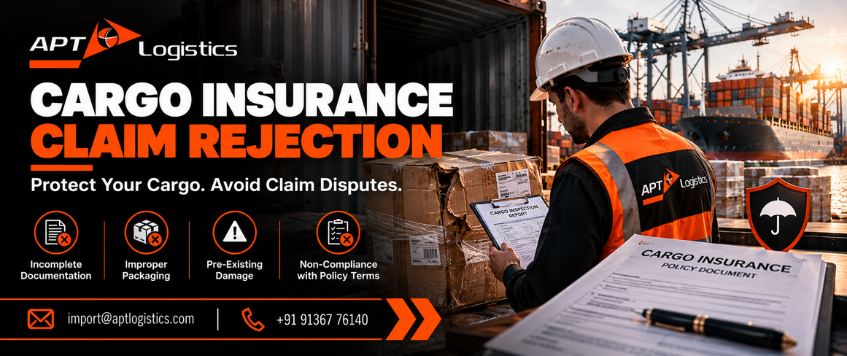
Cargo insurance claim rejection can occur when the loss falls outside the policy coverage, required documents are missing, reporting deadlines are missed, or the insured party cannot establish the cause and extent of damage.
For importers and exporters, understanding these issues before dispatch is essential to protecting cargo value and avoiding unnecessary claim disputes.
8 Common Reasons Why Cargo Insurance Claims Get Rejected
1. The Loss Is Not Covered Under the Policy
One of the most common reasons for claim rejection is that the reported incident is excluded from the insurance coverage.
For example, a policy may cover accidental physical damage but exclude certain losses arising from inadequate packaging, inherent vice, ordinary leakage, or delay.
How to avoid it: Read the insurance policy carefully and understand the insured risks, exclusions, deductibles, and special conditions before shipment.
2. Inadequate or Improper Cargo Packaging
Cargo that is not packed appropriately for international transportation may suffer damage during loading, unloading, stacking, or transit.
If the insurer determines that inadequate packaging caused or contributed to the loss, the claim may be disputed or rejected depending on the policy wording.
How to avoid it: Use suitable export packaging, moisture protection, cushioning, pallets, and cargo-securing arrangements according to the nature of the goods and transport conditions.
3. Delayed Notification of Cargo Damage
Some importers discover cargo damage but wait several days before informing the insurance company or its appointed surveyor.
This can make it difficult to establish when and how the damage occurred. Policies may also contain specific notification requirements.
How to avoid it: Notify the insurer or claims representative immediately after discovering damage. Follow the policy’s notification requirements and preserve the damaged cargo and packaging for inspection.
4. Missing Supporting Documents
An incomplete claim submission can delay assessment or create difficulties in establishing the loss.
Commonly required documents include:
-
Insurance certificate or policy.
-
Commercial invoice.
-
Packing list.
-
Bill of Lading or Air Waybill.
-
Delivery receipt or proof of delivery.
-
Survey report, where applicable.
-
Photographs of damaged cargo and packaging.
-
Claim notice and supporting correspondence.
-
Repair estimates or replacement cost evidence, where relevant.
How to avoid it: Maintain a complete shipment documentation file and submit the documents requested by the insurer.
5. No Evidence of Damage or Loss
Insurance claims require evidence. If the consignee cannot demonstrate the condition of the cargo when received, the insurer may question the circumstances or extent of the reported damage.
How to avoid it: Photograph the cargo before dispatch, during loading where practical, and immediately after delivery if damage is noticed. Record visible damage or shortages on the delivery receipt before signing, where possible.
6. Failure to Take Reasonable Steps to Minimise Loss
After an incident, the insured party is generally expected to take reasonable measures to prevent further damage, subject to safety and policy requirements.
For example, leaving water-damaged cargo exposed to rain without taking reasonable protective measures could increase the loss.
How to avoid it: Protect the affected cargo, arrange appropriate storage or handling, and follow the insurer’s instructions. Keep records of the steps taken.
7. Incorrect Insurance Declaration
Incorrect cargo descriptions, declared values, packing details, or shipment information can create problems during claim assessment.
For example, if the insured cargo description does not match the commercial invoice or transport documents, the insurer may request clarification or dispute coverage.
How to avoid it: Ensure the insurance declaration accurately reflects the commodity, quantity, packaging, invoice value, route, and other information required under the policy.
8. Exceeding the Policy’s Transit or Reporting Conditions
Cargo insurance may specify the insured journey, commencement and termination of cover, geographical limits, and notification requirements.
If cargo is stored beyond the permitted period, transported through an undeclared route, or the claim is submitted outside the applicable time limits, coverage may be affected.
How to avoid it: Check the policy’s transit clauses, storage conditions, geographical scope, and claim notification requirements before arranging transportation.
What Should You Do When Cargo Arrives Damaged?
If imported or exported cargo arrives damaged, take the following steps:
-
Inspect the shipment immediately: Check the outer packaging, container condition, seals, and cargo quantity.
-
Record the damage: Take clear photographs and videos showing the damaged goods, packaging, container number, and seal condition.
-
Make written remarks: Record visible damage or shortages on the delivery receipt, proof of delivery, or relevant delivery documents.
-
Notify the insurer: Report the incident within the policy’s specified notification period.
-
Arrange a survey: Request an inspection by the insurer’s appointed surveyor where required.
-
Preserve evidence: Retain damaged goods, packaging, and relevant documents until the insurer provides further instructions.
-
Submit the claim: Provide the claim form, supporting documents, loss assessment, and other evidence requested by the insurer.
Avoid disposing of or repairing damaged cargo before the insurer or surveyor has had a reasonable opportunity to inspect it, unless urgent action is necessary to prevent further loss.
How Can Importers and Exporters Reduce Cargo Insurance Claim Risks?
Businesses can reduce insurance-related disputes through better shipment preparation and documentation.
Preventive measure Why it matters Select appropriate insurance coverage Helps ensure relevant transportation risks are covered Declare accurate cargo value Reduces valuation discrepancies Use proper export packaging Minimises handling and transit damage Maintain shipment photographs Provides evidence of cargo condition Verify shipping documents Helps establish shipment details Report damage promptly Supports timely claim investigation Maintain survey records Helps establish the nature and extent of loss Remember that cargo insurance policies differ. Coverage depends on the actual policy wording, applicable clauses, exclusions, and circumstances of the loss.
How APT Logistics Helps Protect International Shipments
At APT Logistics, we understand that cargo protection involves more than arranging transportation. Proper packaging, accurate shipment documentation, careful cargo handling, and timely communication are important throughout the logistics process.
Our team coordinates air freight, sea freight, customs clearance, inland transportation, and specialised cargo handling. We also assist customers with shipment-related documentation and coordination when cargo damage or transit issues are reported.
For businesses moving valuable, fragile, or specialised cargo, reviewing insurance requirements before dispatch is an important part of shipment planning.
Conclusion
Cargo insurance claim rejection can create unexpected financial losses for importers and exporters, particularly when cargo damage or shortages occur during international transportation.
Understanding policy exclusions, maintaining accurate documentation, using suitable packaging, and reporting incidents promptly can help reduce claim disputes.
Before every shipment, review the insurance conditions carefully and ensure that the declared cargo details and insured journey match the actual transportation arrangements.
Frequently asked questions
1. Why do cargo insurance claims get rejected?
Claims may be rejected because of policy exclusions, inadequate packaging, incorrect declarations, missing documents, delayed notification, or insufficient evidence of the loss.
2. Does cargo insurance cover all types of shipment damage?
No. Coverage depends on the policy and selected clauses. Some policies provide broader protection, while others cover only specified risks. Exclusions and conditions still apply.
3. What documents are required for a cargo insurance claim?
Common documents include the insurance certificate, commercial invoice, packing list, Bill of Lading or Air Waybill, delivery receipt, photographs, survey report where applicable, and claim form.
4. Can I claim insurance if cargo arrives damaged but the container seal is intact?
Potentially, yes. An intact seal does not automatically mean the cargo is undamaged or that a claim is invalid. The cause of damage, policy coverage, and supporting evidence will determine the claim outcome.
5. What should I do if the insurance company rejects my cargo claim?
Request the insurer’s written explanation and identify the specific policy clause or condition relied upon. Review the evidence and consider submitting additional supporting documents or using the policy’s grievance or dispute-resolution process.
6. Does marine cargo insurance cover delays in shipment?
Ordinary cargo insurance generally does not cover delay-related losses unless specific cover is provided. Check the policy wording and exclusions carefully.
-
Need Help? Chat with us!
Start a Conversation
Hi! Click one of our members below to chat on WhatsApp