-

05
Oct
Freight Consolidator: Meaning, Benefits & How It Works
What Is a Freight Consolidator?
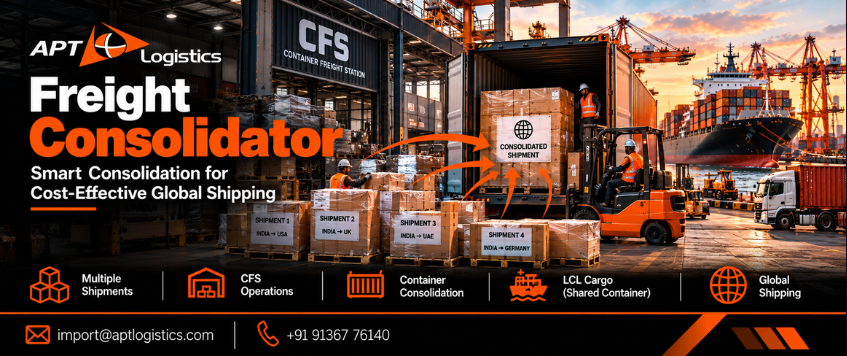
A freight consolidator is a logistics provider that combines shipments from multiple customers into a single transportation movement.
Instead of sending several small shipments separately, a consolidator groups compatible cargo together to make better use of available container or transport capacity.
This is particularly common in LCL (Less than Container Load) shipping, where individual exporters do not have enough cargo to fill an entire container.
For businesses shipping smaller volumes internationally, working with a freight consolidator can provide a practical alternative to booking a full container.
How Does Freight Consolidation Work?
The basic process is straightforward.
1. Cargo Is Collected
Shipments from different exporters are collected at the origin location or delivered to a warehouse or Container Freight Station (CFS).
2. Cargo Is Consolidated
The freight consolidator checks the shipments and groups compatible cargo based on destination, routing, service requirements and other operational factors.
Multiple shipments can then be loaded into one container or transportation unit.
3. Consolidated Cargo Moves Internationally
The container is transported from the origin port to the destination according to the planned sailing or transportation schedule.
4. Cargo Is Deconsolidated
At the destination, the consolidated container is moved to the appropriate facility, where individual shipments are separated and processed for delivery.
5. Final Delivery
After destination formalities and customs clearance, each shipment is released and transported to the respective consignee.
Why Use a Freight Consolidator?
1. Lower Cost for Smaller Shipments
One of the biggest advantages of consolidation is that exporters pay for the space their cargo occupies rather than booking an entire container.
This can make LCL shipping more economical for smaller shipments.
2. Better Container Utilization
Combining multiple shipments improves the utilization of available container space.
Instead of shipping partially empty containers, compatible cargo can share capacity.
3. More Flexible Shipping
Businesses do not always have to wait until they have enough cargo to fill a 20-foot or 40-foot container.
Consolidation allows smaller shipments to move according to available schedules.
4. Access to Multiple Trade Lanes
An experienced freight consolidator may have established consolidation programs and overseas partners covering multiple international destinations.
This can make it easier for smaller exporters to access global markets.
Freight Consolidator vs Freight Forwarder
The terms are sometimes used interchangeably, but they are not always identical.
A freight forwarder arranges transportation and manages logistics on behalf of the customer. A consolidator specifically focuses on combining multiple shipments into a consolidated movement.
A freight forwarding company can also operate as a consolidator or arrange consolidation through its network.
When Should You Consider Consolidation?
Freight consolidation can be suitable when:
- Your shipment is too small to efficiently use a full container.
- You want to reduce the cost of small-volume international shipping.
- Your cargo can be safely consolidated with other compatible shipments.
- You have regular LCL export or import requirements.
- You need access to established consolidation routes.
However, consolidation is not automatically the cheapest option. Transit time, origin and destination handling charges, CFS costs and cargo characteristics should all be considered before selecting LCL or FCL.
How APT Logistics Supports Consolidated Cargo
At APT Logistics, we coordinate LCL and consolidated freight solutions for exporters and importers from India.
Our team evaluates cargo volume, destination, routing and required delivery schedule before recommending a suitable shipping option.
From cargo collection and CFS coordination to documentation, customs clearance and final delivery, we can manage the different stages of the shipment through a coordinated logistics solution.
Conclusion
A freight consolidator helps businesses move smaller international shipments by combining compatible cargo into a shared transportation unit.
For exporters and importers with limited cargo volumes, consolidation can offer greater flexibility and potentially lower transportation costs compared with booking a dedicated container.
The right solution depends on cargo volume, destination, transit time and total logistics costs—not just the basic freight rate.
APT Logistics — Consolidated Freight Solutions from India to Global Markets.
FAQs
What is a freight consolidator?
A freight consolidator combines shipments from multiple customers into a single transportation movement, commonly for LCL cargo.
Is a freight consolidator the same as a freight forwarder?
Not always. A forwarder arranges transportation and logistics services, while a consolidator specifically combines multiple shipments. However, a freight forwarder can also provide consolidation services.
Is freight consolidation cheaper than FCL?
For smaller shipments, LCL consolidation can be more economical than booking a complete container. The total cost should be compared after including CFS, handling, documentation and destination charges.
What types of cargo can be consolidated?
Cargo that is compatible in terms of handling, routing, regulations and transportation requirements can generally be consolidated. Certain hazardous, oversized or specialized cargo may require separate arrangements.
Need Help? Chat with us!
Start a Conversation
Hi! Click one of our members below to chat on WhatsApp