-

18
Sep
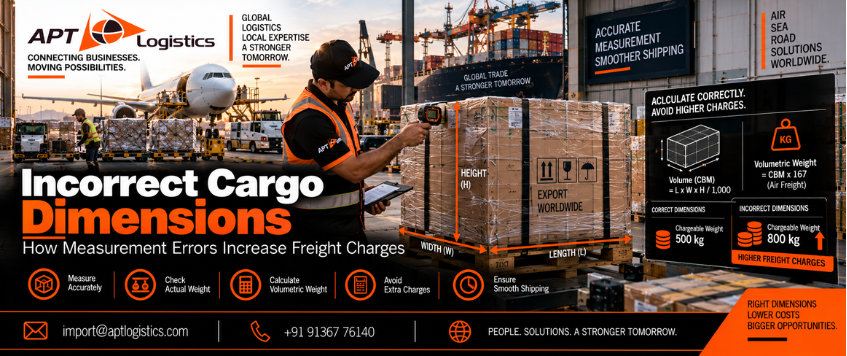
Incorrect Cargo Dimensions: How They Increase Freight Charges
How Wrong Cargo Dimensions Increase Freight Charges
Freight quotations are often based on the weight, volume and dimensions provided by the shipper. If those measurements are inaccurate, the final freight cost may differ significantly from the original quotation.
For businesses managing regular international shipments, avoiding incorrect cargo dimensions is an important part of controlling logistics costs.
1. Incorrect Dimensions Can Change Chargeable Weight
In air freight, the carrier generally considers both actual weight and volumetric weight when determining the chargeable weight.
For example, a lightweight shipment occupying substantial space may be charged based on its volumetric weight rather than its actual weight.
If the dimensions provided at booking are incorrect, the chargeable weight may be recalculated after the cargo reaches the airline or handling terminal.
2. Larger Measurements Mean Higher Volume
Even a small difference in package dimensions can increase the total shipment volume.
For multiple packages, the effect can become significant.
For example, if the actual dimensions are larger than those declared, the freight forwarder or carrier may revise the shipment’s volumetric calculation and issue additional charges.
3. Carrier Remeasurement Can Change the Final Cost
Airlines, shipping lines, terminals and warehouses may measure cargo using their own equipment.
If their measurements differ from the shipper’s declaration, the carrier’s verified dimensions may be used for billing purposes, depending on the applicable terms.
This can result in a freight adjustment after booking.
4. Oversized Cargo Can Require Special Handling
Incorrect dimensions can also create operational problems.
If cargo turns out to be larger than originally declared, it may require:
- Special handling
- Different loading arrangements
- Additional equipment
- OOG/oversized cargo planning
- Revised transportation arrangements
These requirements can increase the overall logistics cost.
5. Trucking Costs Can Also Increase
Dimensions are important not only for international freight but also for inland transportation.
Cargo that is wider, taller or longer than declared may require a different vehicle, additional permits or specialized handling.
This is particularly important for machinery, industrial equipment and project cargo.
How to Avoid Incorrect Cargo Dimensions
Businesses can reduce measurement-related freight adjustments by following a simple process:
- Measure every package after final packing.
- Record length × width × height accurately.
- Weigh the final packed cargo.
- Keep measurements for each package rather than estimating totals.
- Check whether pallets, crates or packaging increase the overall dimensions.
- Share photographs or packing details when handling oversized cargo.
- Reconfirm measurements before final freight booking.
A Simple Example
Suppose a shipment consists of five packages declared as 100 × 80 × 100 cm each.
If the actual packed dimensions are 105 × 85 × 105 cm, the difference across five packages can materially increase the shipment’s total volume.
That seemingly small measurement error can therefore affect the final freight calculation.
How APT Logistics Helps
APT Logistics assists customers with shipment planning by reviewing cargo weight, dimensions, packaging and transportation requirements before booking.
For larger or unusual cargo, accurate measurements help our team evaluate the appropriate equipment, routing and freight option before the shipment moves.
Conclusion
Incorrect cargo dimensions can result in revised chargeable weight, higher freight costs, additional handling requirements and unexpected billing adjustments.
Accurate measurement should therefore be treated as an essential part of shipment planning—not simply a documentation formality.
APT Logistics helps importers and exporters plan cargo movement with accurate shipment information, appropriate freight solutions and end-to-end logistics coordination.
Need Help? Chat with us!
Start a Conversation
Hi! Click one of our members below to chat on WhatsApp