-

16
Sep
Customs Examination Export Cargo: Checklist to Avoid Delays
Checklist to Avoid Customs Examination Delays for Exports
Customs examination can add time to an export shipment, particularly when cargo details, documentation or packaging do not match the information declared to customs.
While examination may be required as part of the customs process, exporters can reduce customs examination export cargo delays by preparing documents and cargo correctly before the shipment reaches the examination stage.
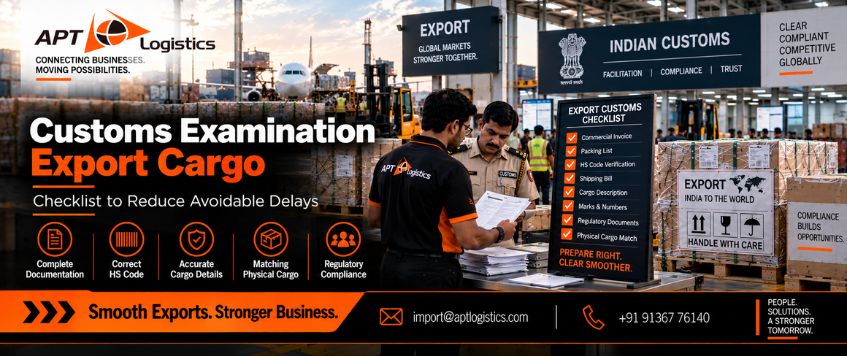
Export Customs Examination Checklist
1. Verify the Commercial Invoice
Make sure the commercial invoice contains accurate:
- Exporter and consignee details
- Product description
- Quantity
- Unit and total value
- Currency
- Country of origin
- Applicable product information
The invoice should clearly describe what is actually being shipped.
2. Check the Packing List
The packing list should correspond with the physical cargo.
Verify:
- Number of packages
- Package type
- Gross and net weight
- Dimensions, where applicable
- Marks and numbers
- Contents of each package
Differences between the packing list and physical cargo can create additional questions during examination.
3. Ensure HS Code Accuracy
Correct classification is an important part of export documentation.
Before filing the export declaration, verify that the HS classification corresponds to the actual product. Incorrect classification can result in queries, amendments or additional checks.
4. Match Documents With Physical Cargo
One of the most important checks is ensuring that the declared cargo matches the actual cargo.
Before customs examination, confirm:
Product + Quantity + Weight + Packaging + Marks = Documents
Any significant discrepancy should be identified and corrected through the appropriate process before shipment movement.
5. Check Regulatory Requirements
Certain products may require specific certificates, licenses, declarations or other regulatory documents.
Exporters should identify applicable requirements well before the cargo reaches the port or airport.
6. Use Proper Cargo Marking
Packages should have clear shipping marks and labels wherever required.
For special cargo, appropriate handling or regulatory markings should also be used.
Clear identification can make physical examination and cargo handling more efficient.
7. Keep Supporting Documents Ready
Depending on the shipment, customs or other authorities may require additional supporting information.
Keeping relevant purchase documents, technical specifications, product literature, certificates and other records readily available can help address queries faster.
8. Coordinate With Your CHA or Freight Forwarder
Good coordination between the exporter, customs broker/CHA, freight forwarder, transporter and terminal is essential.
The logistics team should know:
- Cargo readiness status
- Documentation status
- Customs filing status
- Examination requirements
- Port or airport cut-off
- Planned transportation schedule
This helps prevent avoidable operational gaps.
Why Documentation Accuracy Matters
Customs examination is not always predictable, and selection for examination does not necessarily indicate a documentation problem.
However, accurate documentation and properly prepared cargo can help reduce avoidable delays once an examination is required.
Poor preparation can result in additional clarification, amendments or waiting time, potentially affecting vessel or flight schedules.
How APT Logistics Supports Export Shipments
APT Logistics helps exporters coordinate international shipments with attention to documentation, customs coordination, cargo readiness and transportation planning.
Our team works with exporters and customs professionals to ensure shipment information is properly coordinated before cargo moves toward the port or airport.
Conclusion
Preparing customs examination export cargo correctly can help exporters minimize avoidable delays and maintain smoother shipment schedules.
A simple pre-shipment checklist covering documents, HS classification, cargo details, regulatory requirements and physical packaging can make a significant difference.
APT Logistics supports exporters with freight forwarding, customs coordination and end-to-end logistics solutions designed around their shipment requirements.
Need Help? Chat with us!
Start a Conversation
Hi! Click one of our members below to chat on WhatsApp