-

20
Nov
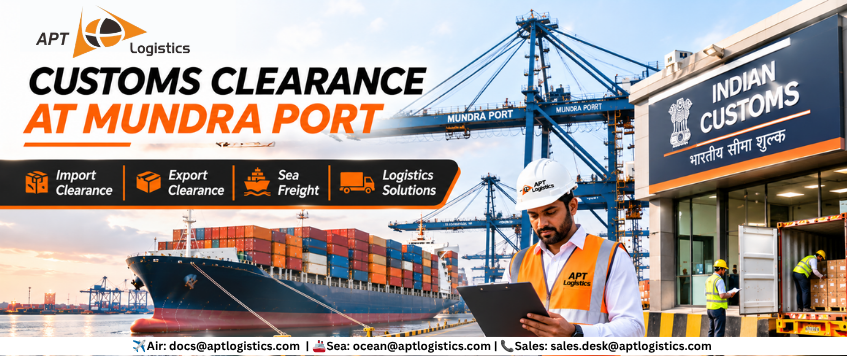
Custom Clearance at Mundra Port: Complete Guide for Importers and Exporters
Custom Clearance at Mundra Port: A Complete Guide for Importers and Exporters
Efficient custom clearance at Mundra Port is essential for businesses involved in international trade. Whether importing machinery, industrial equipment, electronics or exporting commercial goods, completing customs formalities correctly helps avoid unnecessary delays, additional port charges and documentation issues.
Mundra Port in Gujarat is an important gateway for India’s international cargo movement. Importers and exporters use the port for containerised shipments, bulk cargo and specialised cargo. Understanding the customs clearance process and arranging the required documentation in advance can make international shipping operations more efficient.
APT Logistics provides freight forwarding and logistics support to businesses managing import and export shipments through major Indian ports, including Mundra.
What Is Customs Clearance at Mundra Port?
Customs clearance is the process of completing regulatory formalities with Indian Customs before imported goods can be released or export cargo can be permitted for shipment.
For imports, the process generally involves filing the Bill of Entry, assessment of applicable duties, examination where required and obtaining customs clearance for cargo release.
For exports, exporters or their authorised representatives file the Shipping Bill, complete applicable customs formalities and obtain the necessary export clearance.
The exact process depends on the commodity, applicable regulations, customs assessment and shipment documentation.
Import Customs Clearance Process at Mundra Port
1. Arrival of Cargo
When a vessel arrives at Mundra Port, the shipping line or its authorised agent completes the applicable cargo manifest formalities. The cargo is discharged and handled at the designated terminal.
2. Bill of Entry Filing
The importer or authorised customs broker files the Bill of Entry through the Indian Customs electronic system. Details generally include:
-
Importer Exporter Code (IEC)
-
Commercial invoice
-
Packing list
-
Bill of Lading
-
HS code and product description
-
Country of origin
-
Applicable licences or certificates, where required
3. Customs Assessment and Duty Payment
Customs assesses the declared goods, classification, valuation and applicable duties. The importer must pay the assessed customs duty before the applicable clearance and release formalities can be completed.
4. Customs Examination
Depending on the assessment and risk parameters, Customs may order document verification or physical examination of the cargo.
5. Out-of-Charge and Cargo Delivery
Once the required customs formalities are completed and an Out of Charge order is issued, the importer can proceed with terminal and shipping-line release requirements, followed by cargo transportation.
Export Customs Clearance Process at Mundra Port
Export customs clearance ensures that goods comply with applicable export regulations before being shipped internationally.
The general process includes:
-
Preparation of the commercial invoice and packing list.
-
Filing of the Shipping Bill through the customs system.
-
Customs assessment and verification, where applicable.
-
Physical examination if ordered by Customs.
-
Completion of applicable export formalities and Let Export Order (LEO).
-
Cargo movement and loading onto the designated vessel, subject to terminal and carrier requirements.
Exporters should ensure that shipment details, HS codes, cargo descriptions and declared values are accurate.
Documents Required for Customs Clearance
The documents required depend on the commodity, transaction and applicable regulatory requirements. Common documents include:
Import Shipments Export Shipments Commercial Invoice Commercial Invoice Packing List Packing List Bill of Lading Shipping Instructions / Bill of Lading details Bill of Entry Shipping Bill Certificate of Origin, if applicable Certificate of Origin, if applicable Import licences or certificates, if required Export licences or certificates, if required Additional documents may be required for restricted, regulated or specialised commodities.
Common Reasons for Customs Clearance Delays
Importers and exporters may face delays due to:
-
Incorrect HS code classification.
-
Differences between invoice and packing list details.
-
Incomplete or incorrect shipping documents.
-
Missing import or export permissions.
-
Customs examination requirements.
-
Valuation or declaration queries.
-
Delays in duty payment or cargo release coordination.
Preparing documents accurately and checking regulatory requirements before cargo arrival or dispatch can help reduce avoidable delays.
Why Choose APT Logistics for Customs Clearance at Mundra Port?
Choosing an experienced freight forwarding partner can simplify the coordination of customs clearance and cargo transportation.
APT Logistics offers logistics solutions covering:
-
Import and export customs clearance coordination.
-
FCL and LCL sea freight services.
-
Inland transportation from Mundra Port.
-
Warehousing and cargo handling.
-
Project cargo and OOG shipment coordination.
-
Open Top and Flat Rack container solutions.
-
Door-to-door logistics support.
With coordinated freight forwarding and documentation support, APT Logistics helps businesses manage their international shipments through Mundra Port more efficiently.
Frequently Asked Questions (FAQs)
1. How long does customs clearance take at Mundra Port?
The time depends on documentation accuracy, customs assessment, examination requirements, regulatory approvals and payment of applicable duties. There is no fixed clearance timeline for every shipment.
2. What documents are required for import customs clearance at Mundra Port?
Common documents include the commercial invoice, packing list, Bill of Lading, Bill of Entry, IEC details and any commodity-specific licences or certificates.
3. What is the difference between a Bill of Entry and a Shipping Bill?
A Bill of Entry is filed for import clearance, whereas a Shipping Bill is filed for export clearance.
4. Can customs clearance delays result in additional charges?
Yes. Delays may lead to additional terminal storage, shipping-line demurrage or container detention charges, depending on the circumstances and applicable free time.
5. Does APT Logistics provide customs clearance support at Mundra Port?
APT Logistics provides freight forwarding and customs clearance coordination for import and export shipments, along with sea freight and inland transportation solutions.
APT Logistics – Contact Details
For import and export customs clearance, sea freight rates and logistics support at Mundra Port, contact our team.
Department Email Contact Number Air Freight docs@aptlogistics.com +91 79776 10560 Sea Freight ocean@aptlogistics.com +91 99200 20978 Sales sales.desk@aptlogistics.com / sea@aptlogistics.com +91 7700 914 388 Documentation cs1@aptlogistics.com +91 91367 76040 Import cs02@aptlogistics.com +91 9321740903 -
Need Help? Chat with us!
Start a Conversation
Hi! Click one of our members below to chat on WhatsApp