-

19
Nov
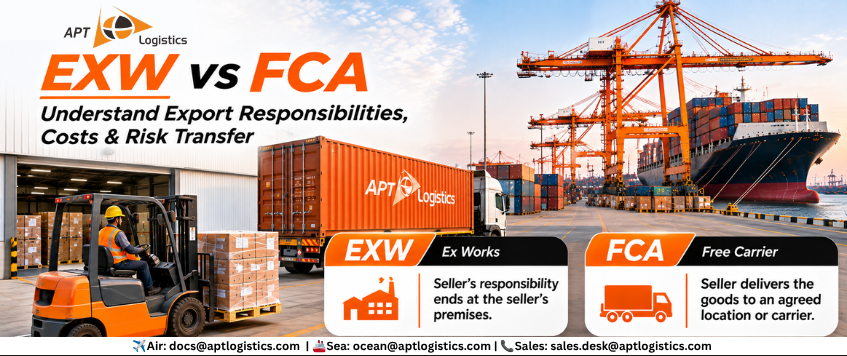
EXW vs FCA: Which Incoterm Gives Exporters Better Control?
EXW vs FCA: Which Incoterm Gives Exporters Better Control?
Choosing the correct Incoterm is an important decision for exporters involved in international trade. Among the commonly used trade terms, EXW vs FCA is a frequent comparison because both involve the buyer arranging the main transportation. However, the responsibilities for export customs clearance, cargo handover and risk transfer are significantly different.
Understanding the difference between EXW and FCA helps exporters select the right shipping arrangement, manage operational responsibilities and avoid unnecessary complications during international cargo movement.
In this guide, we explain how EXW and FCA work, their key differences and which Incoterm generally gives exporters better control.
What Is EXW (Ex Works)?
Under EXW – Ex Works, the seller makes the goods available to the buyer at an agreed location, such as the seller’s factory, warehouse or another named place.
The seller has minimal obligations under EXW. The buyer is generally responsible for arranging transportation, loading (unless otherwise agreed), export clearance, international freight, import clearance and final delivery.
Example:
An exporter in Mumbai sells machinery to a buyer in Germany under EXW Mumbai terms.
-
The exporter makes the machinery available at its factory.
-
The buyer arranges collection and transportation.
-
The buyer is responsible for export and import clearance under the EXW allocation of responsibilities.
-
The buyer arranges international freight and delivery to Germany.
Important: EXW can create practical challenges in international exports because the foreign buyer may not be able to complete export customs formalities in the seller’s country. Under Incoterms 2020, FCA is often more suitable when the seller needs to handle export clearance.
What Is FCA (Free Carrier)?
Under FCA – Free Carrier, the seller delivers the goods to the buyer’s nominated carrier or another nominated person at an agreed location.
Unlike EXW, the seller is responsible for export customs clearance.
FCA can be used for different modes of transportation, including air, sea, road and rail freight.
Example:
An exporter in Mumbai sells machinery to a buyer in Germany under FCA Mumbai Factory terms.
-
The exporter prepares the goods for shipment.
-
The exporter completes export customs clearance.
-
The exporter delivers the goods to the buyer’s nominated carrier at the agreed location.
-
The buyer arranges the main international transportation.
-
Risk transfers when delivery takes place according to the agreed FCA delivery point.
If FCA is agreed at the seller’s premises, the seller is responsible for loading the goods onto the collecting vehicle. If delivery is at another named place, the seller delivers the goods on its arriving vehicle, ready for unloading.
EXW vs FCA: Key Differences
Particulars EXW FCA Full Form Ex Works Free Carrier Export Customs Clearance Buyer Seller Import Customs Clearance Buyer Buyer Main Freight Buyer Buyer Transportation Arrangement Buyer Buyer Loading at Seller’s Premises Buyer Seller Risk Transfer When goods are placed at buyer’s disposal at the named place, not loaded At the agreed FCA delivery point Seller’s Responsibility Minimum Higher than EXW Exporter Control Limited Better control over export formalities Why Does FCA Give Exporters Better Control?
For many exporters, FCA offers a more practical arrangement because the seller manages export customs clearance and can coordinate the cargo handover process.
Here are some important advantages:
1. Better Control Over Export Customs Clearance
Under FCA, the exporter handles export clearance. This allows the exporter to coordinate with its customs broker, prepare required documentation and manage export formalities.
2. Smoother Coordination With Freight Forwarders
Exporters can coordinate cargo readiness, customs examination, documentation and handover requirements with their appointed logistics partners.
3. Reduced Export Compliance Complications
Since the seller handles export clearance under FCA, the arrangement avoids relying on a foreign buyer to complete export formalities in the seller’s country.
4. Suitable for Different Transportation Modes
FCA is suitable for air freight, sea freight, road freight and rail freight shipments. It is particularly useful for containerised cargo and multimodal transportation.
Which Incoterm Should Exporters Choose: EXW or FCA?
The choice depends on the exporter’s operational capabilities, buyer requirements and shipment arrangement.
-
Choose EXW when the buyer is capable of arranging collection and handling export formalities in the seller’s country, and the parties understand the practical implications.
-
Choose FCA when the exporter wants to manage export customs clearance and coordinate the handover of cargo to the buyer’s nominated carrier.
For many international export shipments from India, FCA can be a more practical option than EXW because the exporter remains responsible for export clearance.
How APT Logistics Supports EXW and FCA Shipments
Selecting the right Incoterm is only one part of successful international shipping. Proper coordination of transportation, customs documentation and cargo handover is equally important.
APT Logistics provides freight forwarding solutions for exporters and importers, including air freight, sea freight (FCL and LCL), customs clearance, inland transportation, warehousing and specialised cargo handling.
Whether your shipment moves under EXW or FCA terms, APT Logistics can assist with freight coordination, export logistics planning and transportation arrangements based on your shipment requirements.
Frequently Asked Questions (FAQs)
1. What is the main difference between EXW and FCA?
The main difference is export customs clearance. Under EXW, the buyer is responsible for export clearance, whereas under FCA, the seller handles export clearance.
2. Is FCA better than EXW for exporters?
FCA is often more practical for exporters because they retain responsibility for export customs clearance and can better coordinate export formalities.
3. Who pays for freight under FCA?
Generally, the buyer pays for the main international freight and arranges transportation beyond the agreed FCA delivery point.
4. Can FCA be used for air freight shipments?
Yes. FCA can be used for air, sea, road, rail and multimodal shipments.
5. Who is responsible for loading under EXW and FCA?
Under EXW, the buyer is responsible for loading at the seller’s premises. Under FCA, the seller loads the goods when delivery takes place at the seller’s premises. At another named FCA location, the seller delivers the goods ready for unloading.
6. Which Incoterm is commonly recommended for container exports?
FCA is often more suitable for containerised exports, particularly when the seller delivers the container to a carrier or terminal and handles export clearance. The precise named delivery point should be agreed clearly.
APT Logistics – Contact Details
For assistance with EXW, FCA, export customs clearance, air freight and sea freight shipments, contact our team.
Department Email Contact Number Air Freight docs@aptlogistics.com +91 79776 10560 Sea Freight ocean@aptlogistics.com +91 99200 20978 Sales sales.desk@aptlogistics.com / sea@aptlogistics.com +91 7700 914 388 Documentation cs1@aptlogistics.com +91 91367 76040 Import cs02@aptlogistics.com +91 9321740903 -
Need Help? Chat with us!
Start a Conversation
Hi! Click one of our members below to chat on WhatsApp