-

28
Sep
FCL Shipping India: When Is Full Container Load Economical?
What Is FCL Shipping?
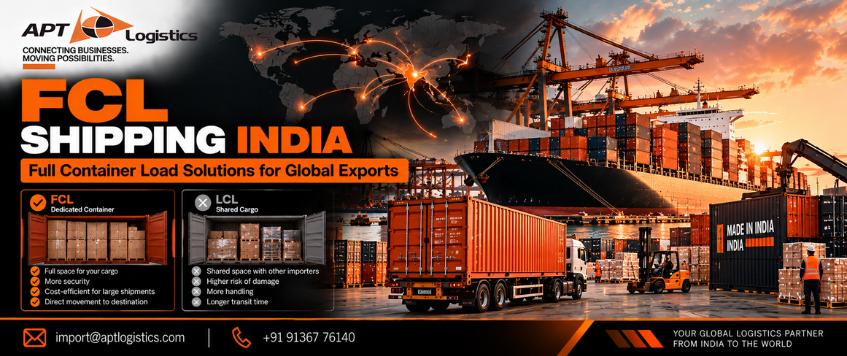
FCL shipping India refers to Full Container Load shipping, where an exporter or importer uses an entire shipping container for their cargo. Unlike LCL (Less than Container Load), FCL cargo generally does not share the container with shipments belonging to other customers.
FCL is widely used for regular commercial exports, large-volume shipments, machinery, industrial goods, garments, chemicals and other cargo that can efficiently utilize a full container.
Depending on the cargo volume and requirements, exporters may use 20-foot or 40-foot containers, including specialized equipment such as Open Top or Flat Rack containers for suitable cargo.
When Is FCL Shipping More Economical?
Choosing FCL is not simply about filling an entire container. The economics depend on cargo volume, destination, freight rates, handling charges and the overall shipment structure.
1. When Cargo Volume Is High
FCL becomes increasingly attractive when the shipment occupies a significant portion of a container.
For example, if an exporter has enough cargo to utilize most of a 20-foot or 40-foot container, paying for an entire container can be more economical than repeatedly booking smaller LCL shipments.
2. When You Ship Regularly
Businesses making frequent exports can benefit from FCL shipping India because container bookings can be planned around regular production and dispatch schedules.
Regular volumes may also allow exporters to negotiate better freight arrangements with shipping lines or freight forwarders.
3. When Cargo Requires Better Control
FCL provides greater control over the container because the cargo is generally not consolidated with unrelated shipments.
This can be particularly useful for sensitive, high-value or carefully packed commercial cargo where minimizing additional handling is important.
4. When Destination Handling Costs Are High
LCL shipments can involve additional consolidation and deconsolidation activities. Depending on the trade lane and destination, these charges can affect the overall landed logistics cost.
FCL can simplify the movement by keeping the shipment within one dedicated container.
5. When Transit Planning Is Important
For businesses working with fixed production schedules, retail deliveries or project cargo, FCL can provide a more structured shipping plan.
The container can be booked according to the required sailing schedule, followed by documentation, customs clearance, port handling and inland transportation.
FCL vs LCL: Which Should You Consider?
The decision depends on the shipment rather than simply choosing the lowest quoted ocean freight.
Factor FCL LCL Cargo volume Medium to large Small to medium Container use Dedicated container Shared container Handling Generally fewer consolidation stages More consolidation/deconsolidation Cost efficiency Often better at higher volumes Often suitable for smaller volumes Planning Suitable for regular shipments Flexible for smaller consignments For exporters, the correct comparison should consider the total logistics cost, including origin charges, freight, destination charges, handling, documentation and inland transportation.
How APT Logistics Helps With FCL Shipping
At APT Logistics, we evaluate the shipment profile before recommending an FCL solution. Our team coordinates container selection, freight booking, documentation, customs clearance, port handling and inland transportation.
Whether you are shipping from Nhava Sheva, Mundra, Chennai, Kolkata, Delhi ICDs or other Indian gateways, our objective is to create a practical FCL solution based on cargo volume, destination and delivery requirements.
Conclusion
FCL shipping India can become more economical when cargo volume is sufficiently high, shipments are regular, and the overall cost of using a dedicated container is lower than repeatedly moving smaller consignments.
The right choice ultimately depends on cargo volume, trade lane, freight rates, handling requirements and total logistics costs. A proper comparison before booking can help exporters control transportation expenses and plan shipments more efficiently.
APT Logistics — Reliable FCL & LCL Freight Solutions from India to Global Markets.
FAQs
What does FCL mean in shipping?
FCL means Full Container Load, where a shipment uses an entire shipping container rather than sharing container space with other cargo.
Is FCL cheaper than LCL?
FCL can be more economical when the shipment volume is large enough to efficiently utilize a container. For smaller shipments, LCL may be more suitable.
What container sizes are available for FCL?
Common options include 20-foot and 40-foot containers, while specialized cargo may require Open Top, Flat Rack or other equipment.
Which is better for regular exports, FCL or LCL?
Regular exporters with sufficient cargo volume often consider FCL because it can simplify planning and provide better cost efficiency at higher volumes.
Need Help? Chat with us!
Start a Conversation
Hi! Click one of our members below to chat on WhatsApp