-

01
Aug
Understand Risk Transfer Points in Incoterms | Logistics Tips | APT Logistics
Logistics Tip: Understand Risk Transfer Points
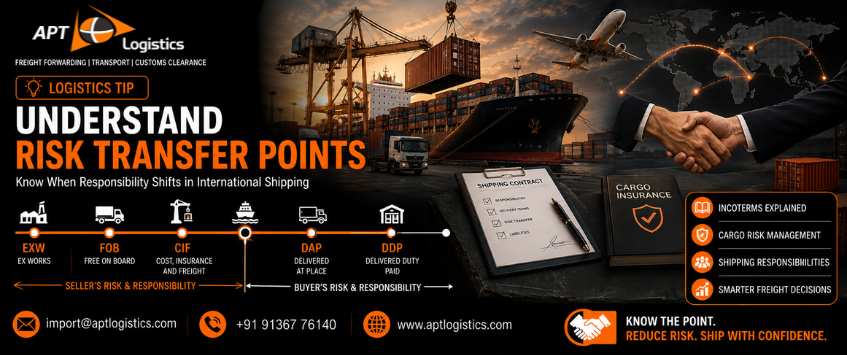
Businesses involved in international trade should understand risk transfer points before shipping cargo. Many importers and exporters assume that the party paying for freight is also responsible for the cargo throughout the journey. However, under Incoterms®, the point where risk transfers from the seller to the buyer may occur much earlier—or later—than expected.
Understanding these risk transfer points helps businesses avoid disputes, manage liabilities, and make informed decisions about cargo insurance and shipping responsibilities.
What Is a Risk Transfer Point?
A risk transfer point is the exact stage in the shipment where responsibility for loss or damage to the cargo moves from the seller to the buyer.
It is determined by the agreed Incoterm—not by who pays the freight charges.
Knowing this point is essential because it defines who bears the financial risk if cargo is damaged, lost, or delayed during transit.
Why Risk Transfer Matters
Misunderstanding risk transfer can result in:
- Unexpected financial losses.
- Insurance claim disputes.
- Buyer and seller disagreements.
- Delayed claim settlements.
- Increased business risks.
Clearly defining responsibilities before shipment protects both parties.
Common Risk Transfer Examples
EXW (Ex Works)
Risk transfers when the buyer collects the goods from the seller’s premises.
Buyer becomes responsible for almost the entire transportation process.
FOB (Free on Board)
Risk transfers once the cargo is safely loaded onboard the vessel at the port of origin.
Although the seller manages export procedures, the buyer assumes cargo risk after loading.
CIF (Cost, Insurance and Freight)
The seller pays for freight and insurance to the destination port.
However, risk still transfers once the cargo is loaded onto the vessel at the origin port, not when it arrives at destination.
This is one of the most misunderstood Incoterms.
DAP (Delivered at Place)
The seller remains responsible until the cargo reaches the agreed delivery location.
Risk transfers only when the goods are made available to the buyer at the destination.
DDP (Delivered Duty Paid)
The seller assumes maximum responsibility, including transportation, customs clearance, duties, and delivery.
Risk transfers only after the goods are delivered to the buyer.
Freight Cost Does Not Equal Risk
One of the biggest misconceptions in international shipping is believing that the party paying freight automatically carries the cargo risk.
In reality:
- Freight payment responsibility.
- Cargo ownership.
- Risk transfer.
- Insurance responsibility.
These are separate concepts under Incoterms®.
Always review the agreed trade term carefully before shipping.
Why Cargo Insurance Is Important
Even when risk transfers to another party, cargo insurance remains an important safeguard.
Insurance helps protect against:
- Cargo damage.
- Theft.
- Fire.
- Natural disasters.
- General Average claims.
- Accidental losses during transit.
Understanding your risk transfer point helps determine when insurance coverage becomes your responsibility.
Best Practices Before Shipping
To minimize disputes and financial exposure:
- Confirm the agreed Incoterm before booking freight.
- Identify the exact risk transfer point.
- Understand each party’s responsibilities.
- Arrange cargo insurance where appropriate.
- Ensure contracts match the agreed Incoterms.
- Discuss responsibilities with your freight forwarder.
APT Logistics Insight ⭐
Many cargo disputes arise because businesses focus on freight charges while overlooking risk transfer. Understanding exactly when responsibility changes hands is just as important as negotiating freight rates. A clear understanding of Incoterms reduces misunderstandings, protects business relationships, and strengthens supply chain planning.
How APT Logistics Helps
APT Logistics supports importers and exporters with:
- Incoterms guidance.
- Air and sea freight solutions.
- Cargo insurance assistance.
- Customs clearance.
- Export and import documentation.
- Risk management consultation.
- End-to-end logistics solutions.
Our experienced team helps businesses choose the right shipping terms and minimize logistics risks.
Conclusion
Businesses that understand risk transfer points are better prepared to manage international shipments, reduce financial exposure, and avoid costly disputes. By understanding when responsibility shifts under each Incoterm, companies can make informed decisions regarding freight planning, insurance, and contractual obligations.
APT Logistics helps businesses navigate every stage of international shipping with expert logistics support, customs expertise, and practical guidance on Incoterms and cargo risk management.
FAQ
What is a risk transfer point?
It is the stage during transportation where responsibility for cargo loss or damage moves from the seller to the buyer under the agreed Incoterm.
Does paying freight mean I carry the cargo risk?
No. Freight payment and risk transfer are different concepts under Incoterms®.
Which Incoterm transfers risk at the destination?
DAP and DDP transfer risk at the agreed destination, unlike FOB or CIF where risk transfers at the origin.
Can APT Logistics help explain Incoterms?
Yes. Our team provides expert guidance on Incoterms, freight planning, customs procedures, and cargo insurance.
Need Help? Chat with us!
Start a Conversation
Hi! Click one of our members below to chat on WhatsApp