-

29
Apr
CIP vs CPT | Key Differences, Cost & Risk Explained | APT Logistics
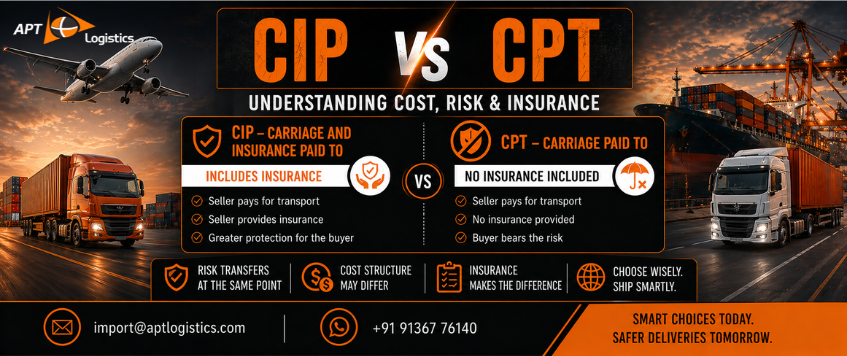
CIP vs CPT | Complete Guide
In international shipping, choosing the right Incoterm can significantly impact cost, risk, and responsibility. Two commonly used terms are CIP (Carriage and Insurance Paid To) and CPT (Carriage Paid To). While they may seem similar, understanding CIP vs CPT is essential for making the right logistics decision.
What is CPT (Carriage Paid To)?
Under CPT, the seller pays for transportation of goods to the named destination. However, the risk transfers to the buyer once the goods are handed over to the first carrier.
Key Features of CPT:
✔ Seller pays freight charges
✔ Buyer bears risk after handover
✔ No insurance included
✔ Suitable for all transport modes
What is CIP (Carriage and Insurance Paid To)?
CIP is similar to CPT, but with one major difference — the seller also provides insurance coverage.
Key Features of CIP:
✔ Seller pays freight charges
✔ Seller provides insurance
✔ Risk transfers early (same as CPT)
✔ Higher cost due to insurance
CIP vs CPT – Key Differences
Factor CIP CPT Full Form Carriage & Insurance Paid To Carriage Paid To Freight Cost Paid by seller Paid by seller Insurance Included Not included Risk Transfer At first carrier At first carrier Cost Level Higher Lower Protection Level Higher Lower
Understanding Risk Transfer
One of the most important aspects in CIP vs CPT is risk transfer.
In both terms:
👉 Risk transfers when goods are handed over to the first carrier — NOT at destination.
This often causes confusion because the seller still pays for transport, but the buyer carries the risk during transit.
Cost Comparison: CIP vs CPT
From a cost perspective:
- CPT is cheaper because it excludes insurance
- CIP is slightly more expensive due to insurance coverage
However, CIP provides better financial protection in case of damage or loss.
When Should You Use CPT?
CPT is ideal when:
✔ Buyer wants lower shipping cost
✔ Buyer is willing to manage insurance
✔ Goods are low-risk or well-packaged
✔ Buyer has experience in logistics
When Should You Use CIP?
CIP is suitable when:
✔ Buyer wants insurance included
✔ Goods are high-value or fragile
✔ Risk mitigation is a priority
✔ Buyer prefers added security
Advantages of CIP
✔ Better protection for cargo
✔ Reduced risk exposure
✔ Simplified insurance arrangement
Advantages of CPT
✔ Lower cost
✔ More flexibility in insurance choice
✔ Suitable for experienced buyers
Common Mistakes to Avoid
🚫 Assuming seller bears risk until destination
🚫 Ignoring insurance requirements
🚫 Not understanding handover point
🚫 Choosing based only on costUnderstanding these differences helps avoid costly errors.
How APT Logistics Helps
APT Logistics helps businesses choose between CIP and CPT by offering:
✔ Cost comparison and analysis
✔ Insurance advisory
✔ Freight planning
✔ End-to-end logistics supportWe ensure you select the right Incoterm based on your shipment needs.
Conclusion
Understanding CIP vs CPT is crucial for managing cost and risk in international shipping. While both terms involve seller-paid freight, the inclusion of insurance in CIP makes it a safer option, whereas CPT offers cost savings.
With APT Logistics, you can make informed decisions and ensure smooth, efficient shipping operations.
Need Help? Chat with us!
Start a Conversation
Hi! Click one of our members below to chat on WhatsApp