-

06
Mar
What is OOG Cargo in Shipping? Complete Guide
Introduction
In international logistics, certain cargo cannot fit inside standard shipping containers due to its size, weight, or dimensions. Such cargo is classified as Out of Gauge (OOG) cargo. Industries such as construction, oil & gas, mining, and manufacturing frequently rely on specialized logistics solutions to transport oversized equipment across countries.
Handling OOG cargo requires careful planning, specialized equipment, and experienced freight forwarders. Companies like APT Logistics provide dedicated solutions for transporting oversized and heavy cargo through sea freight, break bulk shipping, and project cargo handling.
This guide explains what OOG cargo is, how it is shipped, the equipment used, and key considerations in handling oversized cargo.
What is OOG Cargo?
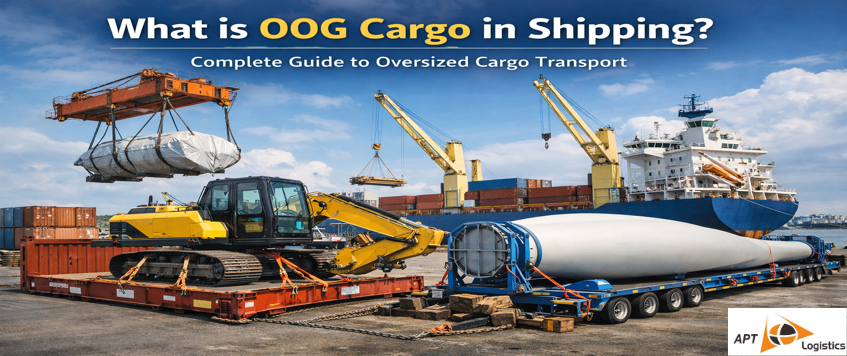
OOG (Out of Gauge) cargo refers to freight that exceeds the standard dimensions of shipping containers.
A standard container typically has size limits such as:
- 20 ft container: approx. 5.9m length
- 40 ft container: approx. 12m length
- Standard width: 2.35m
- Standard height: 2.39m
If cargo exceeds length, width, or height, it becomes out of gauge cargo.
Examples include:
- Industrial machinery
- Construction equipment
- Wind turbine blades
- Transformers
- Large generators
- Mining equipment
- Steel structures
- Such cargo cannot be loaded into a conventional container and requires special container types or break bulk shipping.
Types of OOG Cargo
OOG cargo can fall into several categories depending on how the dimensions exceed container limits.
1. Height OOG
Cargo exceeds the container height.
Example:
Industrial machinery taller than the container roof.Solution:
Open Top Containers
2. Width OOG
Cargo exceeds container width.
Example:
Wide machinery or steel structures.Solution:
Flat Rack Containers
3. Length OOG
Cargo extends beyond the container length.
Example:
Long pipes or wind turbine blades.Solution:
Flat Rack or Break Bulk Shipping
4. Overweight Cargo
Some cargo may fit inside the container dimensionally but exceeds weight limits.
Example:
- Transformers
- Heavy generators
- Industrial press machines
These shipments require specialized loading and lifting equipment.
Equipment Used for OOG Cargo Transport
Handling oversized cargo requires specialized containers and shipping equipment.
Flat Rack Containers
Flat rack containers are commonly used for OOG cargo. They have open sides and collapsible ends, allowing cargo to extend beyond the container frame.
Common uses:
- Heavy machinery
- Industrial equipment
- Construction vehicles
Open Top Containers
Open top containers have no fixed roof, allowing cargo to be loaded from the top using cranes.
Typical cargo:
- Tall machinery
- Industrial equipment
- Large structures
Break Bulk Shipping
When cargo cannot fit even on flat racks, it is transported using break bulk vessels.
Cargo is loaded individually instead of inside containers.
Examples include:
- Turbine components
- Steel structures
- Large generators
How OOG Cargo is Loaded
Transporting oversized cargo requires detailed planning and coordination.
Step 1: Cargo Assessment
The logistics provider measures:
- Length
- Width
- Height
- Weight
- Center of gravity
This determines the type of container and vessel required.
Step 2: Route Planning
Not all routes can handle oversized cargo. The logistics team evaluates:
- Port handling capability
- Crane capacity
- Road transport limitations
Step 3: Securing Cargo
Cargo must be properly secured using:
- Lashing chains
- Turnbuckles
- Wooden blocking
- Steel supports
Improper securing can cause cargo movement during transit.
Step 4: Loading and Transport
Cargo is loaded using heavy equipment such as:
- Cranes
- Forklifts
- Hydraulic trailers
It is then transported via sea freight, break bulk shipping, or multimodal logistics solutions.
ALSO READ | Project Cargo Handling in India
Industries That Use OOG Cargo Shipping
Many industries rely heavily on oversized cargo transportation.
Construction Industry
- Excavators
- Bulldozers
- Tower crane parts
Oil & Gas
- Drilling equipment
- Pipes and structures
Energy Sector
- Wind turbine blades
- Transformers
- Power plant equipment
Mining Industry
- Crushers
- Mining trucks
- Processing equipment
Challenges in OOG Cargo Shipping
Transporting oversized cargo presents several challenges.
Port Restrictions
Some ports cannot handle large or heavy equipment.
Safety Risks
Improper loading can damage cargo or vessels.
Documentation and Permits
Special permits may be required for oversized shipments.
Higher Costs
OOG cargo shipping involves:
- Special containers
- Crane handling
- Engineering planning
Why Choose Professional Logistics Providers
Handling OOG cargo requires experience and technical expertise. Professional freight forwarders manage:
- Cargo inspection
- Route planning
- Vessel booking
- Documentation
- Safe loading and lashing
Companies such as APT Logistics specialize in handling project cargo, break bulk shipments, flat rack containers, and open top container logistics, ensuring oversized cargo is transported safely and efficiently.
Conclusion
OOG cargo plays a critical role in global trade, especially for industries dealing with large machinery, heavy equipment, and industrial components. Because these shipments exceed standard container dimensions, they require specialized handling, equipment, and logistics planning.
With the right freight forwarding partner and proper cargo management, businesses can transport oversized cargo across international markets safely and efficiently.
For companies dealing with large equipment and project shipments, working with experienced logistics providers like APT Logistics ensures smooth coordination from planning to final delivery.
Need Help? Chat with us!
Start a Conversation
Hi! Click one of our members below to chat on WhatsApp