-

09
Apr
Freight Rate Calculation Guide | Air & Sea Freight Costs Explained
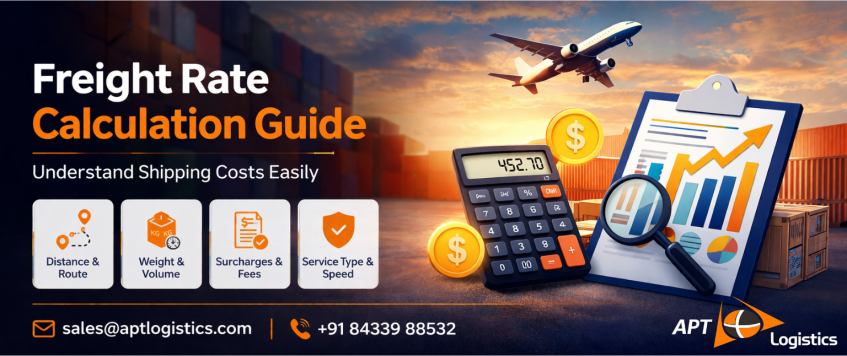
Freight Rate Calculation Guide
Understanding how freight rates are calculated is essential for businesses involved in international shipping. A clear freight rate calculation guide helps you estimate costs, plan budgets, and avoid unexpected charges.
Freight costs vary depending on multiple factors such as shipment size, weight, mode of transport, and destination.
Key Factors Affecting Freight Rates
1. Weight and Volume 📦
For air freight, charges are based on chargeable weight, which is the higher of actual weight or volumetric weight.
For sea freight, container size (FCL) or volume (LCL) plays a major role.
2. Mode of Transport 🚢✈️
- Air Freight: Faster but more expensive
- Sea Freight: Cost-effective but slower
The choice of transport directly impacts the total freight cost.
3. Distance and Route 🌍
Longer distances and complex routes increase shipping costs. Trade routes, fuel consumption, and transit time all influence pricing.
4. Fuel Surcharges ⛽
Fuel price fluctuations lead to additional surcharges, especially in air freight.
5. Type of Cargo
Special cargo such as perishable, hazardous, or oversized goods may involve additional handling charges.
6. Seasonality and Demand
Freight rates increase during peak seasons due to high demand and limited capacity.
Air Freight Rate Calculation
Air freight charges are calculated using chargeable weight:
Formula:
Chargeable Weight = Higher of (Actual Weight or Volumetric Weight)Volumetric Weight formula:
(L × W × H in cm) ÷ 6000Example:
If cargo dimensions are 100 × 100 × 100 cm:
Volumetric weight = 166.67 kgIf actual weight is 120 kg → charged on 166.67 kg
APT Logistics helps you calculate accurate air freight costs and optimize shipment planning.
Sea Freight Rate Calculation
FCL (Full Container Load)
- Fixed rate per container (20ft / 40ft)
- Includes ocean freight + surcharges
LCL (Less than Container Load)
- Charged based on volume (CBM)
- Formula: 1 CBM = 1000 kg (whichever is higher)
Additional charges may include:
- Terminal handling charges
- Documentation fees
- Customs clearance
- Delivery charges
Additional Costs to Consider
Freight rate is not the only cost. Businesses should also account for:
- Port and terminal charges
- Customs duties and taxes
- Insurance
- Warehousing
- Inland transportation
How APT Logistics Helps
APT Logistics provides transparent and competitive pricing with:
- Accurate freight cost calculation
- Best carrier selection
- Cost optimization strategies
- End-to-end logistics support
- Real-time shipment updates
With industry expertise, APT Logistics ensures you get the most efficient and cost-effective shipping solutions.
Conclusion
A proper freight rate calculation guide helps businesses understand shipping costs and make informed decisions. By considering all factors and working with experienced logistics partners, companies can optimize costs and improve supply chain efficiency.
With APT Logistics, you can simplify freight calculations and ensure smooth international shipping.
Need Help? Chat with us!
Start a Conversation
Hi! Click one of our members below to chat on WhatsApp