-

16
Mar
Flat Rack vs Open Top Container | Shipping Container Guide
Flat Rack vs Open Top Container: Understanding the Key Differences
When shipping oversized or heavy cargo, standard containers are often not suitable. Businesses involved in project cargo or heavy equipment transport must choose between specialized containers such as flat rack vs open top container. These containers are designed to handle cargo that exceeds standard container dimensions.
Understanding the difference between flat rack vs open top container helps businesses select the right shipping equipment for safe and efficient cargo transport.
What is a Flat Rack Container?
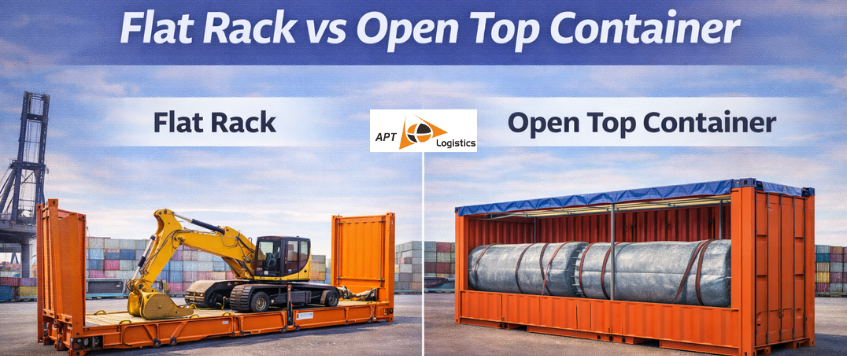
A flat rack container is a container with no side walls and sometimes no roof, but with strong end walls. It is designed to carry heavy or oversized cargo that cannot fit inside a standard container.
Key Features of Flat Rack Containers
- No side walls for easier loading
- Strong end walls to secure cargo
- Suitable for very wide or heavy cargo
- Can be loaded from the top or sides
Common Cargo Shipped in Flat Rack Containers
Flat rack containers are commonly used for:
- Heavy machinery
- Construction equipment
- Industrial machinery
- Large pipes or steel structures
These containers are ideal when cargo width exceeds the size of standard containers.
What is an Open Top Container?
An open top container is similar to a standard shipping container but without a fixed roof. Instead, it has a removable tarpaulin cover that protects cargo during transportation.
Key Features of Open Top Containers
- Open roof for top loading
- Covered with waterproof tarpaulin
- Similar structure to standard containers
- Suitable for tall cargo
Common Cargo Shipped in Open Top Containers
Open top containers are often used for:
- Large machinery
- Industrial equipment
- Timber or pipes
- Glass or steel coils
These containers are ideal for cargo that is too tall to fit in a standard container.
Flat Rack vs Open Top Container: Main Differences
Feature Flat Rack Container Open Top Container Side Walls No side walls Full side walls Roof No roof Open roof with tarpaulin Best For Very wide or heavy cargo Tall cargo Loading Method Side or top loading Mainly top loading Cargo Security Cargo secured externally Cargo enclosed inside container Both containers serve different purposes depending on the size, weight, and shape of the cargo.
ALSO READ: What is OOG Cargo in Shipping? Complete Guide
Choosing the Right Container for Oversized Cargo
Selecting the correct container is essential for safe shipping. Businesses must consider several factors before deciding between flat rack vs open top container, including:
- Cargo dimensions
- Weight of the shipment
- Loading requirements
- Transport route and safety requirements
Experienced logistics providers help businesses determine the most suitable container type for their cargo.
APT Logistics – Specialized Container Shipping
APT Logistics provides professional logistics solutions for oversized cargo shipments, including shipments requiring flat rack vs open top container options. With experience in handling project cargo and specialized equipment, the company helps businesses move heavy and oversized cargo safely.
APT Logistics supports clients with:
- Flat rack container shipping
- Open top container transport
- Project cargo logistics
- Cargo loading and securing
- Freight forwarding and shipping coordination
With strong logistics planning and operational expertise, APT Logistics ensures that oversized cargo shipments move smoothly across global trade routes.
Conclusion
Understanding the difference between flat rack vs open top container helps businesses choose the right container for oversized cargo. Each container type serves specific cargo requirements depending on size, weight, and loading needs.
With professional logistics expertise and specialized cargo handling, APT Logistics helps businesses transport oversized cargo safely using the most suitable container solutions.
Need Help? Chat with us!
Start a Conversation
Hi! Click one of our members below to chat on WhatsApp