-

12
May
Documents Required for Each Incoterm | Complete Shipping Guide
Documents Required for Each Incoterm | APT Logistics
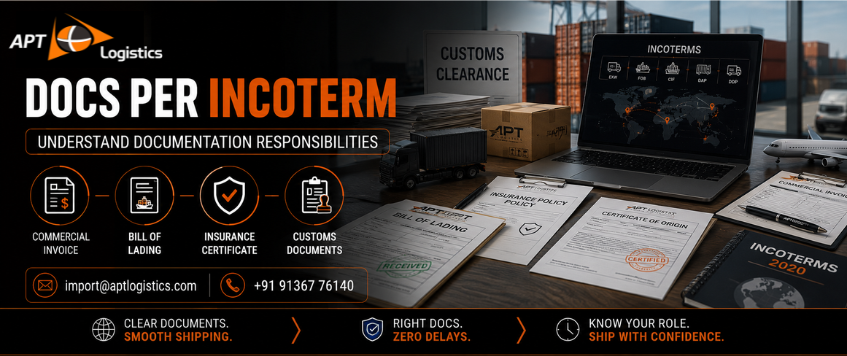
Documentation is one of the most important parts of international shipping. Different shipping terms define not only transportation responsibility but also who handles export and import paperwork. Understanding the documents required for Incoterms helps businesses avoid customs delays, compliance issues, and unexpected costs.
Each Incoterm impacts documentation responsibility differently, making proper coordination essential for smooth cargo movement.
Why Documentation Matters in International Shipping
Incorrect or incomplete paperwork can result in:
- Customs delays
- Cargo holds
- Additional charges
- Shipment rejection
- Regulatory penalties
Proper documentation ensures faster customs clearance and smoother logistics operations.
Common Shipping Documents
Before understanding Incoterm-specific responsibilities, here are the most commonly used documents in international trade:
Document Purpose Commercial Invoice Declares cargo value and transaction details Packing List Details package quantity, dimensions, and weight Bill of Lading / Airway Bill Proof of shipment and transport contract Certificate of Origin Confirms manufacturing country Insurance Certificate Provides cargo insurance proof Export License Required for regulated goods Import License Required by destination country Customs Declaration Used for export/import clearance
Documentation Responsibility by Incoterm
EXW (Ex Works)
Under EXW:
👉 Buyer handles most documentation responsibilities.
Seller Provides:
✔ Commercial invoice
✔ Basic product detailsBuyer Handles:
- Export documentation
- Customs clearance
- Freight paperwork
- Import documents
EXW often creates documentation complexity for buyers.
FCA (Free Carrier)
Under FCA:
👉 Seller handles export clearance and delivery documentation.
Seller Handles:
- Export customs documents
- Commercial invoice
- Transport handover documents
Buyer Handles:
✔ Main freight paperwork
✔ Import clearance documentsFCA offers a more balanced documentation structure.
FOB (Free On Board) 🚢
FOB is commonly used for sea freight.
Seller Handles:
- Export documentation
- Port handling paperwork
- Bill of Lading coordination
Buyer Handles:
✔ Import documentation
✔ Destination customs clearanceFOB simplifies export compliance for buyers.
CFR and CIF
These terms are similar to FOB regarding documentation.
Seller Provides:
- Export documents
- Freight documents
- Bill of Lading
CIF Additional Requirement:
✔ Insurance certificate
The inclusion of insurance makes CIF documentation slightly more extensive.
CPT and CIP ✈️
Under CPT and CIP:
Seller Handles:
✔ Export documentation
✔ Freight booking documentsCIP Additional Requirement:
✔ Cargo insurance documentation
These terms are widely used in multimodal transport.
DAP (Delivered At Place)
Under DAP:
Seller Handles:
- Export paperwork
- Freight documentation
- Delivery coordination documents
Buyer Handles:
✔ Import customs documentation
✔ Duties and taxes paperwork
DDP (Delivered Duty Paid)
DDP requires the seller to manage almost all shipping documents.
Seller Handles:
- Export clearance documents
- Import customs paperwork
- Duty and tax documentation
- Delivery paperwork
Buyer Responsibility:
✔ Minimal documentation involvement
This makes DDP convenient but documentation-intensive for sellers.
Incoterms Documentation Comparison Table
Incoterm Export Docs Import Docs Insurance Docs EXW Buyer Buyer Buyer FCA Seller Buyer Buyer FOB Seller Buyer Buyer CFR Seller Buyer Buyer CIF Seller Buyer Seller CPT Seller Buyer Buyer CIP Seller Buyer Seller DAP Seller Buyer Buyer DDP Seller Seller Seller
Common Documentation Mistakes ⚠️
1. Incorrect Commercial Invoice
Wrong product value or HS code can delay customs clearance.
2. Missing Insurance Proof
Important under CIF and CIP shipments.
3. Incomplete Customs Paperwork
Can result in penalties and cargo holds.
4. Confusion Over Responsibility
Many disputes arise because parties misunderstand who handles specific documents.
How APT Logistics Helps
APT Logistics simplifies documentation management through:
- Export and import documentation support
- Customs clearance coordination
- Freight paperwork handling
- Compliance assistance
- End-to-end logistics solutions
We ensure accurate and timely document processing for smooth cargo movement.
Conclusion
Understanding the documents required for Incoterms is essential for avoiding delays and ensuring compliance in international trade. Since documentation responsibility changes across shipping terms, businesses must clearly understand their obligations before shipping cargo.
With APT Logistics, businesses can streamline shipping documentation and improve logistics efficiency worldwide.
Need Help? Chat with us!
Start a Conversation
Hi! Click one of our members below to chat on WhatsApp